What is Hojicha tea?
Written by Dian VAULTIER·
In Brief
- Hojicha occupies a unique place in the classification of Japanese green teas: unlike sencha or gyokuro, it undergoes roasting that radically transforms its chemical and sensory profi…
- Hojicha originated in Kyoto at the beginning of the twentieth century, from a desire to make use of bancha leaves and stems deemed too common for export.
- HOLLIN sommelier expertise: what is Hojicha tea, decoded by a purist Tea House based in Sartrouville (Île-de-France), offering teas with no added flavourings and shipping its grand crus worldwide.
Hojicha occupies a unique place in the classification of shaded Japanese green Japanese green teas: unlike sencha or gyokuro, it undergoes roasting that radically transforms its chemical and sensory profile. This pyrolysis stage develops notes of caramel and toasted hazelnut, while significantly reducing the caffeine content. Hojicha thus illustrates how the same cultivar can give rise to contrasting taste experiences depending on the processing applied.
Origin and roasting process
Hojicha originated in Kyoto at the beginning of the twentieth century, from a desire to make use of bancha leaves and stems deemed too common for export. Roasting at high temperatures, generally between 180 and 200 degrees Celsius, takes place in a ceramic pan or rotary oven.
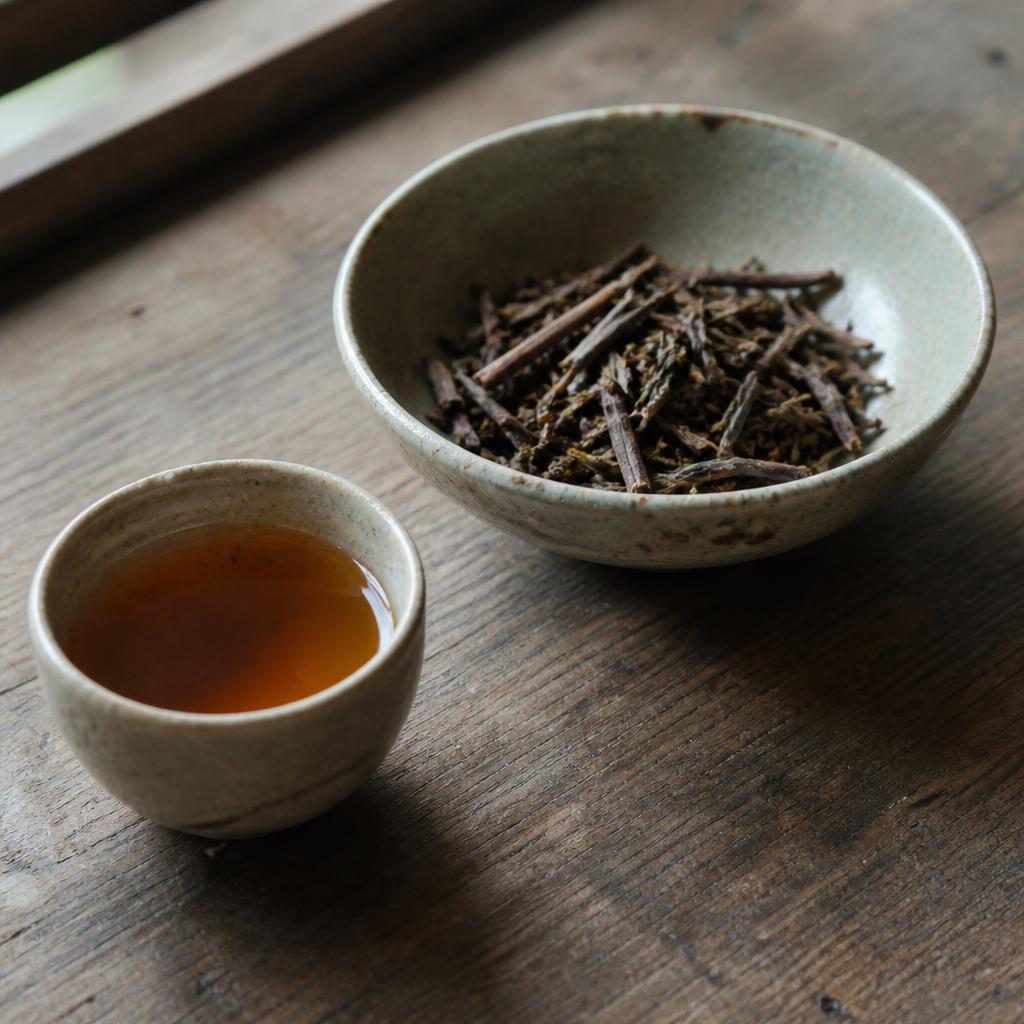
This intense heat triggers a Maillard reaction between the sugars and amino acids in the leaf, generating pyrazine compounds responsible for the characteristic roasted aromas. The leaf changes from green to russet brown, while the liquor takes on an amber hue.
Impact on biochemical composition
Significantly reduced caffeine
The heat from roasting breaks down a significant proportion of the alkaloids present in the leaf, particularly caffeine. Hojicha thus becomes one of the least stimulating Japanese teas, which explains its popularity at the end of the day or among people sensitive to caffeine.
Transformed catechins
Catechins, which are sensitive to heat, are also partially broken down during roasting, giving way to less astringent compounds. What Hojicha loses in bitterness, it gains in roundness and toasted notes.
How to brew Hojicha with precision
Hojicha can withstand hotter water than other green teas Japanese, between 90 and 95 degrees Celsius, without developing excessive bitterness, precisely because its catechins have already been partially transformed by roasting. A brewing time oftime time of 30 to 45 seconds is enough to reveal its aromas of caramel and toasted grain.
It is also well suited to hot winter preparations served after a meal, where its low caffeine content and roundness make it an easy-to-digest alternative to coffee.
The purist selection of HOLLIN
Our HOLLIN du Goût counter, located at 22 avenue de la République, 78500 Sartrouville, open Monday to Saturday from 10h to 20h, offers a selection of whole-leaf and powdered Hojicha, allowing this tea to be explored through its different forms of consumption, fromtime the classic to the Japanese latte.
Our advisers guide you towards the roast level best suited to your preferences, from the mildest and milkiest to the most intensely roasted, for a gradual discovery of this unusual family of green tea.
The birth of a roasted tea
hojicha originated in Kyoto in the nineteen twenties, from an act of thrift that became an act of style: roasting late-harvest leaves, stems and broken leaves rather than discarding them. After a few minutes in a drum heated to between one hundred and fifty and two hundred degrees, the green leaves take on a mahogany hue and release pyrogenic compounds, those roasted molecules also found in warm bread, roasted hazelnuts and cedarwood.
Roasting also transforms the leaf's internal chemistry. Some of the most astringent catechins break down, caffeine is reduced, and the liquor loses its bite. The result is a round, almost comforting tea, whose amber colour often deceives eyes accustomed to green teas Japanese.
Preparing and serving Hojicha
Unlike sencha, hojicha can withstand hot water, between ninety and one hundred degrees, for around thirty seconds for five grams of leaves in a three-hundred-millilitre teapot. This generous temperature awakens the roasted notes without introducing bitterness. The leaf allows for two to three herbal teas successive infusions, each gentler than the last.
Its low caffeine content makes it the quintessential evening tea, served after a meal, to children as well as to those sensitive to caffeine. In cooking, it infuses a cream, a panna cotta or a rice pudding with a woody roundness that no green tea. Our lovers of roasted notes find in it a natural extension of the black teas of the house.
To continue this exploration beyond the screen, step through the door of the HOLLIN du Goût counter, our contemporary Asian grocery located at 22 avenue de la République in Sartrouville. Here, the leaves are opened, smelled and discussed, and every recommendation is tailored to your water, your teapot and your time of day.
Frequently Asked Questions (FAQ)
- Is Hojicha suitable for people sensitive to caffeine?
- Yes, roasting breaks down a significant proportion of the caffeine present in the leaf, making Hojicha considerably less stimulating than other green teas Japanese teas. It is nevertheless advisable to consume it in moderation at the end of the day if you are particularly sensitive.
- Can Hojicha latte be prepared like a matcha latte?
- Yes, Hojicha powder lends itself very well to this preparation. Whisk a spoonful of powder into a little hot water, then add hot dairy or plant-based milk. The caramel and hazelnut notes pair naturally with the milky texture, without dominant bitterness.
- What is the difference between Hojicha and black tea in terms of taste?
- Hojicha remains a green tea non-oxidised but roasted, while the black tea results from complete enzymatic oxidation. Hojicha develops notes of caramel and toasted grain, lighter and less tannic than the malty depth typical of black tea.