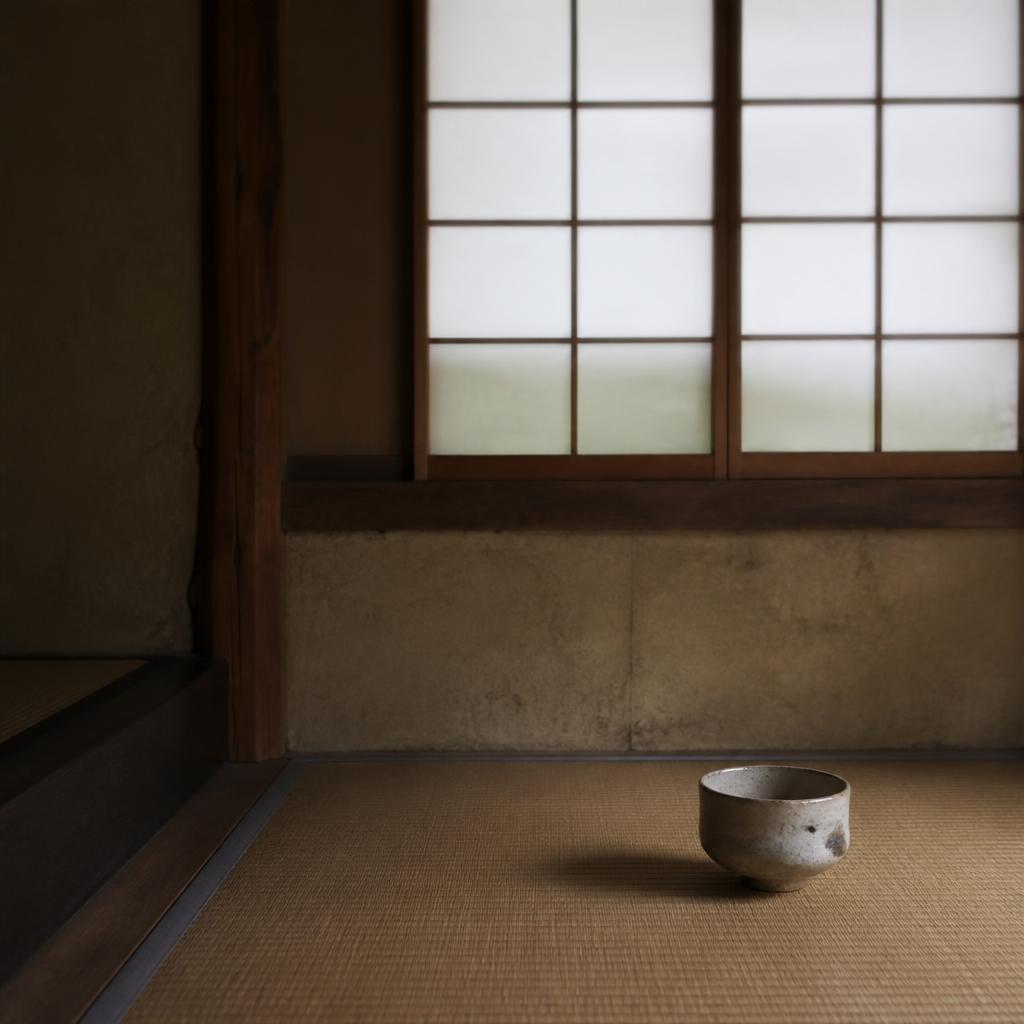
The chashitsu, architecture of the Japanese tea house
Written by Dian VAULTIER·
In Brief
- The chashitsu is not a room decorated in the Japanese style: it is an architectural device designed to produce a state of attention.
- The entrance reserved for guests measures approximately 66 centimeters on each side.
- HOLLIN sommelier expertise: the chashitsu, the architecture of the Japanese tea house decoded by a purist Tea House, with no added flavorings, based in Sartrouville (Île-de-France) and shipping its grand crus worldwide.
The chashitsu is not a room decorated in the Japanese style: it is an architectural device designed to produce a state of attention. Every constraint, from the low door to the four-and-a-half-tatami module, addresses a specific issue of perception and social hierarchy, inherited from the codification established by Sen no Rikyu in the sixteenth century.
The nijiriguchi, a door that imposes equality
The entrance reserved for guests measures approximately 66 centimeters on each side. It forces everyone to bow, to crawl inside, and physically prevents the carrying of a sword, which the samurai had to leave on an outdoor rack. The dimension is not symbolic: it physically constrains the body.
This passage creates a rupture. Crossing a threshold on all fours momentarily erases the visitor's social status, whatever it may be, and forces a change in posture and breathing rhythm. The room is thus separated from the outside world by a gesture, not by a mere spatial boundary.
The garden leading to it, the roji, extends the same logic: a path of irregular stones that forces visitors to watch their feet, and a water basin, tsukubai, for rinsing their hands and mouth. The entire approach is a protocol of deceleration.
The four-and-a-half-tatami module, a functional proportion
The classic configuration, yojohan, measures approximately 2,73 meters on each side, or some 7,4 square meters. At this size, the host can serve each guest without rising more than necessary, and the gaze takes in the entire room, including every preparation gesture.
Rikyu pushed this reduction to two tatamis in the Taian pavilion, designated a national treasure. At this scale, the distance between host and guest falls below one meter: each breath can be heard, the sound of simmering water becomes the dominant auditory event, and all superfluous conversation becomes impossible.
The ceiling is not flat but composed of several heights and materials, lower above the host, higher above the guests. This subtle asymmetry establishes a spatial hierarchy without relying on any furniture or visible demarcation.
The tokonoma, the only permitted focal point
The slightly raised alcove holds a single calligraphic scroll and a minimal floral arrangement, the chabana. A single object, changed according to the season and the guest: rarity creates attention. A room containing ten remarkable objects makes none of them noticeable.
The guests bow to the tokonoma before sitting down, examining the scroll. This moment establishes the theme of the gathering, which will generally not be made verbally explicit. Architecture carries the discourse in place of words.
Light, materials and wabi-sabi
The windows, often made of bamboo lattice covered with washi paper, frame no view: they diffuse even light, with no dominant direction, preventing the eye from being drawn outside. Their irregular placement is calculated to illuminate the host's gestures rather than the space.
The materials are deliberately humble and raw: unfired earth, unpolished wood sometimes retaining its bark, bamboo, straw. This aesteawabi-sabi aesthetics value wear and irregularity, not out of nostalgia, but because an irregular surface holds the gaze longer than a perfect surface.
Bringing the principles into the home, without recreating a pavilion
None of these principles requires tatamis. What matters is applying the three underlying rules: a single visual focal point within the field of vision, a deliberate reduction in the objects present, and a threshold marking the transition to a different rhythm.
A low tray, a surface cleared of all screens, a source of indirect light, and a single object to contemplate are enough to recreate the conditions for attention. The quality of the session will then depend on gesture and material, not on the authenticity of the décor.
The leaf itself remains central. A pure tea, whose aroma is not manufactured but arises from oxidation and the artisan's work, gives this attention something to examine. A flavored tea delivers its message in a second and cannot sustain attention over time.
The purist selection of HOLLIN
We select our teas and our objects according to the same exacting standards as the chashitsu: few references, each one justifiable. We taste every batch before listing it, and we work exclusively with pure teas.
To see and handle these pieces, visit the Comptoir HOLLIN du Goût, 22 avenue de la République, 78500 Sartrouville, Monday to Saturday from 10h to 20h. A bowl must be judged in the hand, never from a photograph.
Frequently Asked Questions (FAQ)
- Why is the entrance door to the chashitsu so low?
- The nijiriguchi, approximately 66 centimeters on each side, forces every guest to crawl inside, physically neutralizing differences in social rank and preventing swords from being carried indoors. Beyond its historical function, this bodily constraint marks a clear break with the outside world and imposes a change in posture and rhythm from the threshold onward.
- Are tatamis necessary to practice tea seriously at home?
- No. Tatamis are a unit of measurement and a working surface, not a prerequisite for the practice. The transferable principles are reducing the number of visible objects, having a single focal point, and creating a threshold that marks a change in rhythm. A clear low table, indirect light, and the absence of a screen are enough to recreate the conditions for attention.
- What is the difference between a chashitsu and a simple Japanese tea room?
- A tearoom is a commercial establishment where beverages are served; the chashitsu is a ritual space designed for chanoyu, with codified dimensions, orientation, and furnishings. Everything is calculated to structure attention and the hierarchy of gazes, from the varying ceiling heights to the tokonoma, whereas a tearoom aims for comfort and service.