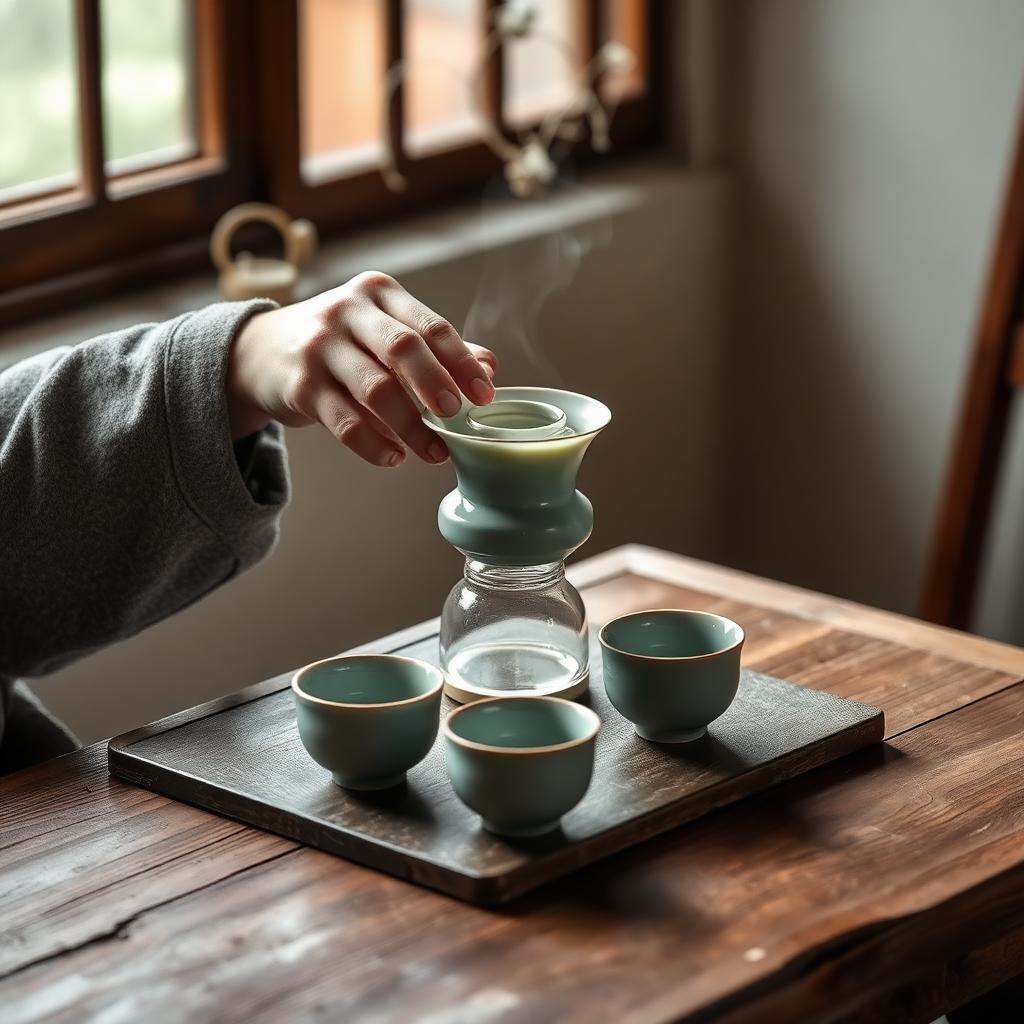
What does 'Cha Dao' (the way of tea) mean? History, gestures and practice
Written by Dian VAULTIER·
In Brief
- Cha Dao, literally the way of tea, refers in China to a discipline in which preparing the leaf becomes an exercise in attention and precision rather than a simple act of…
- The first foundational text is the Cha Jing, the Classic of Tea, written by Lu Yu in the eighth century under the Tang dynasty.
- The expertise of the HOLLIN sommelier: what does 'Cha Dao' (the way of tea) mean, decoded by a purist Tea Maison, with no added flavourings, based in Sartrouville (Île-de-France) and shipping its grand crus worldwide.
Cha Dao, literally the way of tea, refers in China to a discipline in which preparing the leaf becomes an exercise in attention and precision rather than a simple act of consumption. It is neither a religion nor folklore: it is a methodological framework, born under the Tang, that requires the practitioner to control every variable of thetime and to observe what this control produces in the cup.
Historical origins: from Lu Yu to Japanese chanoyu
The first foundational text is the Cha Jing, the Classic of Tea, written by Lu Yu in the eighth century under the Tang dynasty. In ten chapters, the work codifies the botanical origin of the teaier, harvesting tools, the making of tea cakes, water quality and the tending of the fire. Lu Yu establishes a decisive idea: the quality of a cup is the sum of technical decisions, each of which can be assessed.
Under the Song, the practice became more refined with whisked powdered tea, the direct ancestor of Matcha, and tasting competitions. Chan monks transmitted the method to Japan, where it gave rise to chanoyu, formalized in the sixteenth century by Sen no Rikyu around four principles: harmony, respect, purity and tranquillity.
In China, the way took another form from the Ming onwards, when thetime of whole leaves replaced powder. Gong fu cha, literally tea made with application and skill, became the practical expression of Cha Dao: a small teapot, a high dose, very short, repeated infusions, and close attention to the evolution of the liquor.
The aesthetic principles: wabi-sabi and economy of gesture
The wabi sabi aesthetic, associated with chanoyu, values acknowledged imperfection, wear and restraint. A bowl whose glaze shows an irregularity, a utensil burnished through use, an uncluttered room: these choices are not decorative, they remove anything that might divert attention from the liquor and the moment.
Economy of gesture follows the same logic. Every movement in the preparation, from warming the utensils to the final pour, is stripped of anything superfluous. This constraint is not ceremonial as a matter of principle: an unnecessary gesture introduces an uncontrolled variable, heat loss or uneven extraction.
What Cha Dao is not
Cha Dao is not a wellness ritual and has nothing to do with personal development discourse. It promises no health benefits and requires no expensive equipment. Reducing the way of tea to a photographic aesthetic or a vocabulary of relaxation is precisely the opposite of what the Cha Jing proposes: a rigorous method of observation.
Nor is it a rigid formalism. Schools differ, gestures vary from one region to another, and the only constant is the attention paid to the relationship between technical decision and sensory result.
Translating the way of tea into a daily practice
Putting it into practice rests on a few principles that can be maintained every day. Choose water with low mineral content, whose dry residue remains below 50 mg/L. Weigh the leaf rather than estimate it. Control the temperature to the nearest degree according to the tea family. Time the infusion, at least the first few times, to build a reliable memory of durations.
Then comes observation. Smell the dry leaf, then the wet leaf after the first passage, then the cooled infused leaf: each of these stages reveals information that the cup alone does not provide. Tasting the same leaf over three or four herbal teas successive infusions teaches more about a cru than a dozen isolated tastings.
Gong fu cha is particularly well suited to this layered reading. A oolong roasted, infused for twenty seconds, then thirty, then forty, successively reveals its floral notes, mineral structure and fire-roasted depth. It is this progression that the way of tea seeks to make perceptible.
HOLLIN's purist approach
Our position follows directly from this tradition: if the way of tea consists in observing what the leaf produces, then any added flavouring makes the exercise impossible. We therefore work exclusively with pure teas, tasted batch by batch, whose profile comes from the terroir, oxidation and the work of fire.
For those wishing to experience gong fu cha, the necessary objects remain simple: a small teapot or gaiwan, a scale, a thermometer. Our selection of objects for tea is designed for this use, without decorative excess.
All this can be practised at the Comptoir HOLLIN du Goût, 22 avenue de la République, 78500 Sartrouville, Monday to Saturday from 10h to 20h, where we conduct sessions ofherbal teas successive infusions open to all.
Frequently Asked Questions (FAQ)
- What is the difference between Chinese Cha Dao and Japanese chanoyu?
- Chinese Cha Dao focuses primarily on thetime of whole leaves and favours reading a particular harvest through successive passages, often in gong fu cha. Japanese chanoyu, inherited from the Song period, is based on powdered whisked tea, the Matcha, and a codified choreography for welcoming the guest. The first focuses on analysing the leaf, the second on the relationship between host and guest.
- Is expensive equipment needed to practise gong fu cha at home?
- No. A 100 to 150 millilitre porcelain gaiwan, kitchen scales accurate to the gram, a temperature-controlled kettle and two small cups are enough to conduct a complete session. Yixing clay or celadon ware brings genuine nuances to certain families of tea, but it is never a prerequisite for understanding the method.
- How many successive infusions can be drawn from the same leaf in gong fu cha?
- It depends on the density of the leaf and how it was processed. A oolong rolled into tight balls commonly yields six to ten passages, a white tea made from buds four to six, a green tea Chinese three to four. The session ends when the liquor loses its texture and length on the palate, usually before the colour disappears completely.