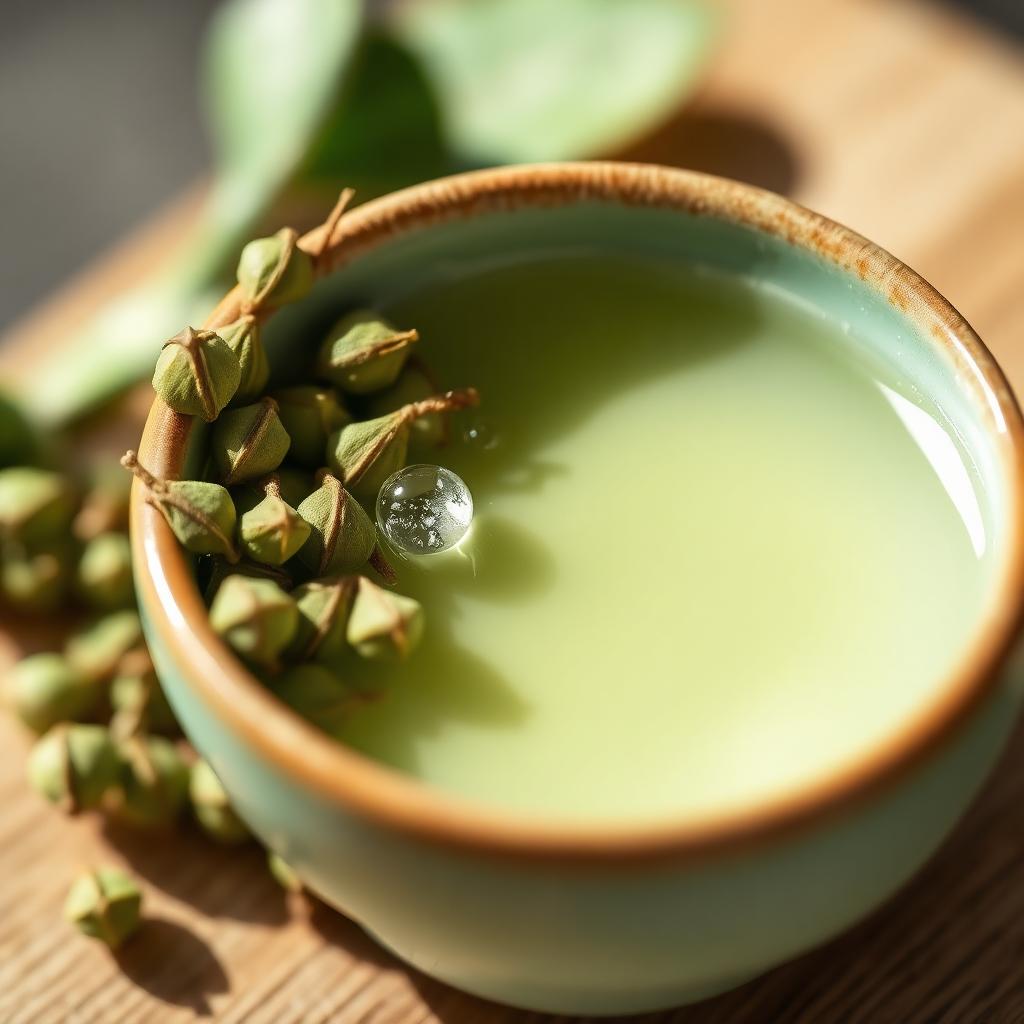
Where does tea’s natural sweetness come from? (L-theanine and amino acids)
Written by Dian VAULTIER·
In Brief
- The sweetness perceived in a fine cup of tea comes not from sugar but from the free amino acids in the leaf, led by L-theanine, complemented by a fraction of soluble carbohydrates.
- L-theanine is a non-protein amino acid, found almost exclusively in the tea plant.
- HOLLIN’s tea sommelier expertise: where tea’s natural sweetness comes from, decoded by a purist Tea Maison, with no added flavourings, based in Sartrouville (Île-de-France) and shipping its fine teas worldwide.
The sweetness perceived in a fine cup of tea comes not from sugar but from the free amino acids in the leaf, L teaanine foremost, complemented by a fraction of soluble carbohydrates. These molecules are extracted very early and at low temperatures, whereas bitter catechins migrate later and at higher temperatures. Sweetness is therefore as much a matter of biochemistry as of adjustingtime.
L-theanine, the signature molecule of Camellia sinensis
L-theanine is a non-protein amino acid, almost specific to the tea plant. It alone accounts for between 50 and 60 percent of the free amino acids in the leaf. Synthesised in the roots from glutamic acid and ethylamine, it is transported to the young shoots, where it accumulates, before being gradually converted into polyphenols under the effect of sunlight.
From a sensory perspective, L-theanine activates umami receptors and produces a round, velvety sensation, both savoury and sweet, that envelops the palate and lengthens the finish. It is highly soluble in water, including cold water, which explains why a time short or cold infusion immediately brings this sweetness to the fore.
The other amino acids present, glutamine, arginine, serine and theogalline, complete this foundation. Their total, expressed as a percentage of dry matter, is one of the most reliable indicators of the quality of a green tea: above 3 percent, the leaf enters the realm of fine teas.
Shading, harvest and cultivar: what concentrates sweetness
Light is the enemy of L-theanine. Under intense exposure, the plant converts this amino acid into catechins intended to protect it from ultraviolet rays. The balance between sweetness and bitterness is therefore directly determined by the amount of radiation received by the leaf in the weeks preceding harvest.
Shading, a concentration technique
In Japan, shade cultivation consists of covering the tea plants for twenty to thirty days before picking, reducing light by 70 to 90 percent. The conversion of L-theanine stops, chlorophyll increases, and the resulting leaf is a deep green, exceptionally rich in umami. This is the principle behind gyokuro and the tencha leaf intended for Matcha.
The result is spectacular when tasted: an almost syrupy liquor, barely astringent, whose sweetness lingers for several minutes after swallowing. These teas are drunk at low temperatures, between 50 and 60 degrees, precisely to extract only this sweet fraction.
The early harvest and the cultivar
The first spring harvest concentrates the reserves accumulated by the plant during its winter dormancy. The buds then contain their highest levels of amino acids of the entire year, and this richness decreases with each successive picking of the season. A tea from the second or third harvest will be livelier, more tannic, less sweet.
The cultivar also plays its part: some Japanese selections, such as Saemidori or Gokou, are renowned for their exceptional L-theanine content, while others favour aromatic intensity. The choice of plant therefore precedes the choice of technique.
Extracting sweetness rather than bitterness: the settings
Extraction is differential: each family of molecules has its own kinetics. Amino acids dissolve from 50 degrees and within the very first seconds. Caffeine follows quickly. Catechins, meanwhile, require a higher temperature and a longer contact time. The profile of the same leaf can therefore be controlled solely through the combination of time and temperature.
For a green tea Japanese, aim for 60 to 70 degrees and 45 to 60 seconds. For a Chinese green tea, 75 to 80 degrees and 2 minutes. For a oolong lightly oxidised, 85 degrees in herbal teas short, repeated infusions of 20 seconds, allowing the sweetness to unfold with each successive infusion. The water should remain low in minerals, with a dry residue below 50 mg/L, so as not to mask this subtlety.
Adding sugar to a properly brewed liquor saturates the same taste receptors stimulated by L-theanine, thereby erasing precisely what the leaf had to say. A tea that needs to be sweetened is almost always over-extracted or made from low-quality broken leaves.
Why HOLLIN works only with pure tea
Natural sweetness is fragile: it is the first characteristic masked by an added flavouring. A tea flavoured with caramel or vanilla obscures the leaf’s umami structure and makes the difference between a fine tea and an ordinary leaf impossible to detect. Our catalogue therefore consists exclusively of pure teas, tasted batch by batch.
This approach is confirmed on the palate. Our counter HOLLIN du Goût, 22 avenue de la République, 78500 Sartrouville, open Monday to Saturday from 10h to 20h, offers comparative tastings in which the same leaf is infused at 60 and then at 85 degrees. The difference in perceived sweetness is immediate, and owes nothing to an additive.
Frequently Asked Questions (FAQ)
- Why is my green tea bitter when it is supposed to be sweet?
- In the vast majority of cases, the water is too hot or thetime too long. Above 80 degrees and two minutes for a green tea Japanese, the catechins dominate the liquor and overwhelm the amino acids extracted at the beginning of the infusion. Lower the temperature to 65 degrees for 60 seconds and the same sachet of leaves will yield a round, sweet cup.
- Is L-theanine found in every family of tea, or only in green tea?
- It is present in all Camellia sinensis leaves, and therefore in white teas, green, oolongs and black teas. Its relative proportion nevertheless decreases with oxidation, which transforms some of the compounds in the leaf, and with exposure to sunlight before harvest. The green teas and bud-based white teas retain the highest concentration.
- Does cold infusion really increase the perceived sweetness of a tea?
- Yes, and the mechanism is well documented. Cold water effectively extracts the highly soluble amino acids, while leaving most of the catechins in the leaf due to insufficient thermal energy. A time of 8 to 12 hours in the refrigerator therefore produces a distinctly sweeter, less caffeinated liquor than the same leaf infused hot.