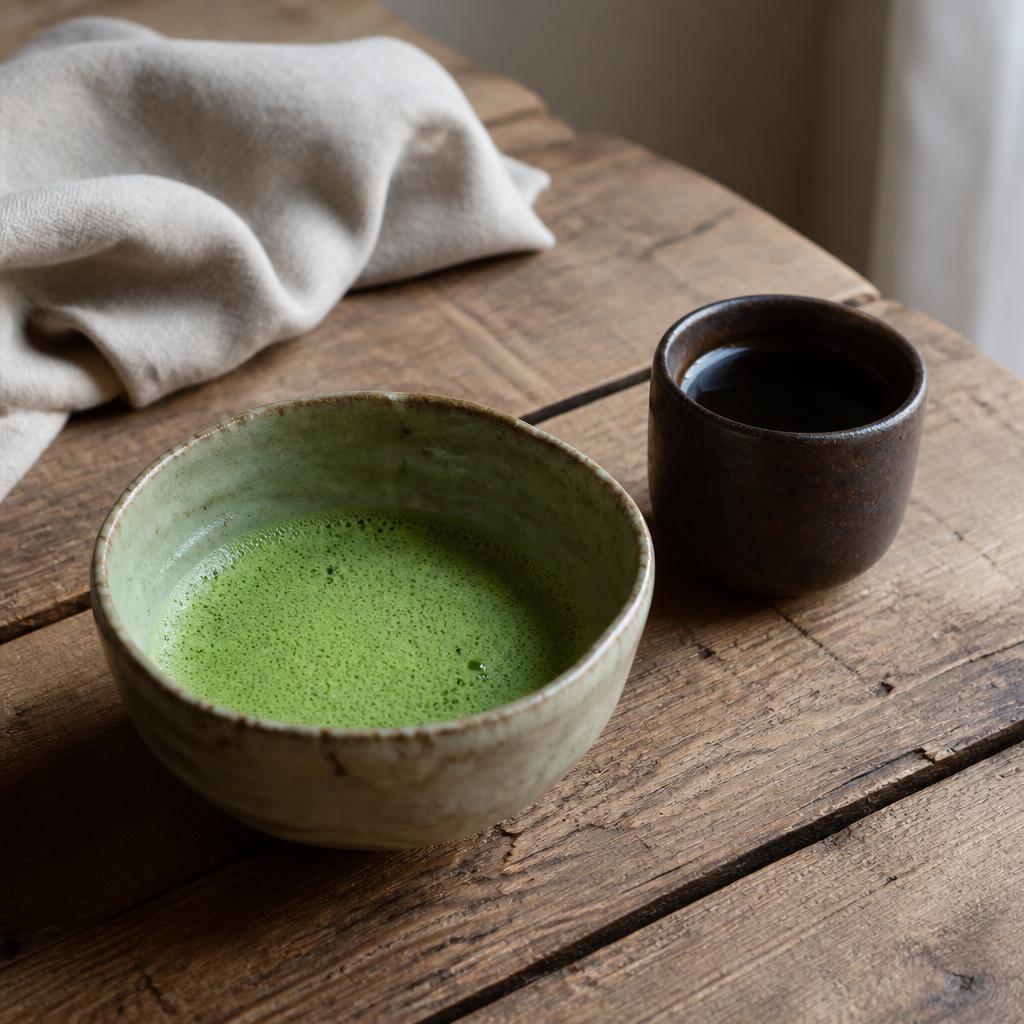
Matcha or coffee: which one truly gives you energy?
Written by Dian VAULTIER·
In Brief
- Coffee and matcha deliver the same stimulant molecule, caffeine, but produce two radically different alertness curves.
- The caffeine in filter coffee reaches its peak plasma concentration in around thirty to forty-five minutes.
- The expertise of the HOLLIN sommelier: Matcha or coffee decoded by a purist Tea Maison, with no added flavourings, based in Sartrouville (Île-de-France) and shipping its fine teas worldwide.
Coffee and Matcha deliver the same stimulant molecule, caffeine, but produce two radically different alertness curves. The first creates a rapid peak followed by a drop; the second establishes a sustained plateau. The difference lies not in the dose but in the speed of absorption and the presence of an amino acid absent from coffee beans.
Same molecule, two absorption kinetics
The caffeine in filter coffee reaches its peak plasma concentration in approximately thirty to forty-five minutes. Absorption is rapid, blood concentration rises sharply, then declines with a half-life of four to six hours. This downward slope, combined with the release of occupied adenosine receptors, produces the sensation of a mid-morning crash.
The Matcha delivers a broadly comparable dose, between 60 and 80 milligrams per bowl prepared with 2 grams of powder, but its absorption is slower. The catechins and tannins in the leaf form complexes with the caffeine that are absorbed less rapidly, spreading its release over several hours.
The result is not less energy but energy distributed differently: a lower peak, a shallower dip, a smaller range of alertness over a longer period. For sustained intellectual work, this is the most useful curve; for brief, intense exertion, coffee retains a real advantage.
L-theanine, the benefit coffee does not possess
The Matcha, made from leaves shaded for three to four weeks before harvest, contains a high concentration of L-teaanine. This amino acid crosses the blood-brain barrier and is associated with an increase in alpha-wave activity, a marker of relaxed alertness, distinct from both sedation and excitement.
In the presence of caffeine, L-theanine reduces the peripheral manifestations of stimulation: nervous tension, fine tremors, increased heart rate. Alertness rises without a corresponding increase in anxiety, something coffee, which lacks this amino acid, structurally cannot offer.
Acidity, stomach and digestive tolerance
Coffee is acidic, with a pH generally between 4,8 and 5,2, and stimulates gastric secretion. On an empty stomach, this combination explains the burning and discomfort reported by many morning drinkers, independently of the caffeine itself.
The Matcha is close to neutral, between 6.5 and 7.5 depending on the water used. It is better tolerated on an empty stomach by most people, with one caveat: its richness in catechins can cause nausea in sensitive individuals if drunk on a completely empty stomach and at a high concentration.
Tea, Matcha included, also reduces the absorption of plant-based non-haem iron, due to its polyphenols. In cases of confirmed deficiency, consume it one hour away from meals rather than eliminating it.
The gradual substitution protocol
Abruptly replacing coffee with Matcha can lead to unpleasant withdrawal: headaches, irritability and reduced alertness for three to five days, caused by the readjustment of adenosine receptors, not by any lack of matcha. Gradual substitution avoids this episode entirely.
An effective method is to keep your morning coffee during the first week and replace only the 11h cup with a Matcha usucha, 2 grams for 70 millilitres of water at 75 degrees. In the second week, reverse the order: Matcha in the morning, coffee as an option in the afternoon.
Expect the sensation to be less dramatic at first. The absence of a peak is often interpreted as an absence of effect, when it is precisely the quality being sought: the best indicator is not how you feel during the first hour, but the absence of a dip at 11am and 3pm.
The purist selection of HOLLIN
Since Matcha is consumed in its entirety, the quality of the powder is not a refinement but a necessity. We taste each batch before listing it, check its colour, fineness of grind and bitterness on the finish, and never add flavourings or sugar.
To judge the difference between a Matcha and a culinary powder, visit the HOLLIN du Goût counter, 22 avenue de la République, 78500 Sartrouville, Monday to Saturday from 10h to 20h. The difference in green colour and finish is immediately apparent, bowl against bowl.
Frequently Asked Questions (FAQ)
- How much caffeine does a bowl of matcha contain compared with an espresso?
- A bowl of usucha prepared with 2 grams of powder provides approximately 60 to 80 milligrams of caffeine, compared with 60 to 80 milligrams for a single espresso: the quantities are similar. The difference lies in the kinetics, the absorption of the Matcha slowed by catechins, replacing the peak with a plateau lasting three to five hours.
- Can matcha cause palpitations like coffee?
- It is much rarer, thanks to L-theanine, which modulates the nervous component of caffeine. Palpitations remain possible with high consumption, beyond three bowls a day, in someone who is highly sensitive or metabolises caffeine slowly. In this case, reduce the amount to 1.5 grams of powder per bowl and avoid consuming any after 3pm.
- Can matcha be drunk on an empty stomach in the morning without discomfort?
- Most people tolerate it well, as Matcha is close to a neutral pH, unlike coffee. Some people may nevertheless experience mild nausea due to the concentration of catechins on an empty stomach. Simply prepare it a little more diluted, 2 grams for 100 millilitres, or drink it after a few bites of food.