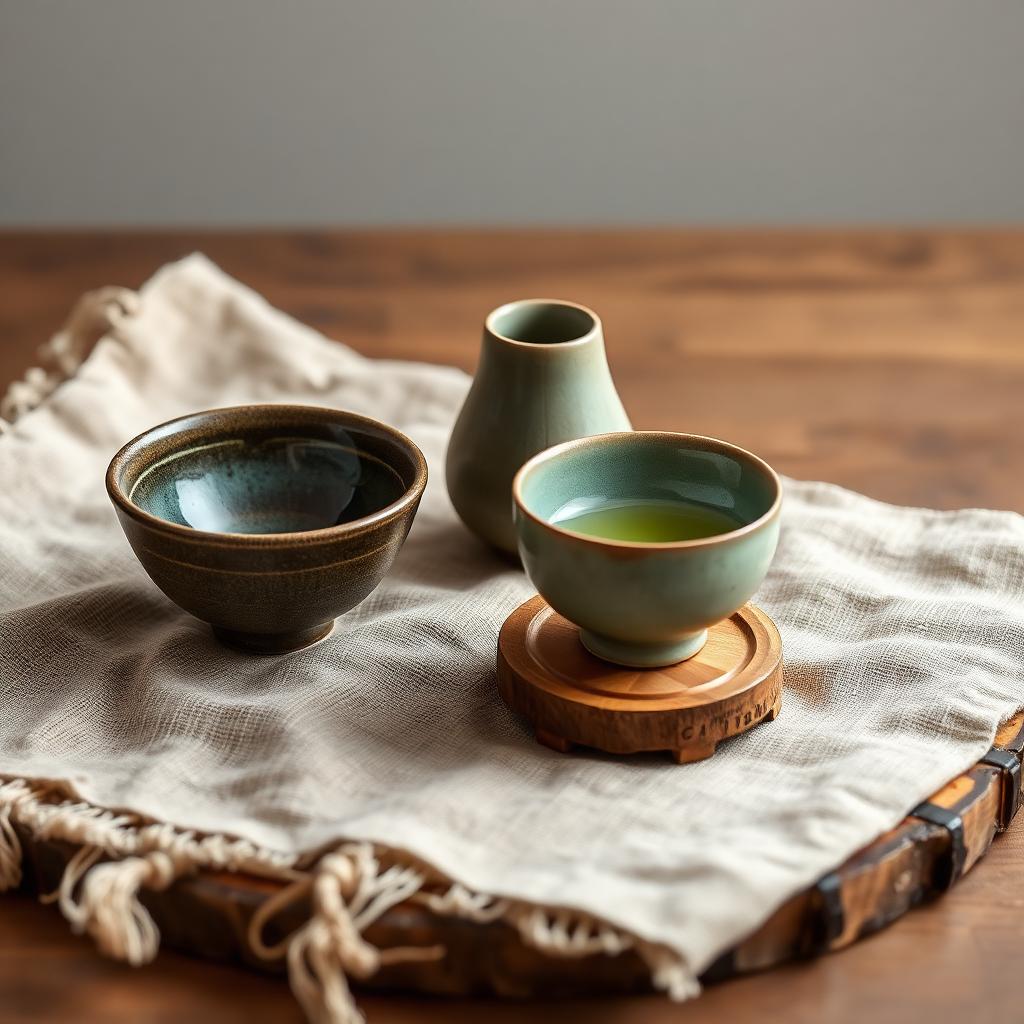
Why the shape of the tea bowl (chawan) changes everything
Written by Dian VAULTIER·
In Brief
- A chawan is not a decorative container: it is an instrument whose geometry determines the quality of the emulsion, the cooling rate and the way the aromas reach the…
- Whisking matcha means creating an emulsion: incorporating air into a suspension of very fine plant particles to form a dense, stable foam.
- HOLLIN sommelier expertise: why the shape of the tea bowl (chawan) changes everything, explained by a purist Tea House with no added flavourings, based in Sartrouville (Île-de-France) and shipping its grand crus worldwide.
A tea bowl is not a decorative container: it is an instrument whose geometry determines the quality of the emulsion, the cooling rate and the way the aromas reach the nose. Changing the bowl alters the taste of the same Matcha measurably, without any time having changed.
The bowl's geometry governs the foam
Whisking a Matcha means creating an emulsion: incorporating air into a suspension of very fine plant particles to form a dense, stable foam. The chasen, a bamboo whisk, moves rapidly in a W or M motion across the full width of the bowl, and the available range of movement determines the volume of air incorporated.
A bowl that is too narrow restricts the range of movement: the whisk strikes the sides, agitation is confined to the centre, and the foam remains coarse and collapses within seconds. Conversely, a bowl that is too wide spreads the liquid into a thin film, leaving the chasen without enough depth to whisk effectively.
The usual compromise is around 12 centimetres in diameter and 7 to 8 centimetres high, with a flat base. The flat base is essential: it gives the chasen an even surface against which to disperse clumps of powder, the very ones that form the lumps visible on the surface of a Matcha poorly prepared.
Season, thickness, and the bowl's thermal properties
Japanese tradition distinguishes between the summer natsu jawan, wide and flared, and the winter fuyu jawan, narrower and deeper. The reasoning is not symbolic but thermal: a large surface of liquid exposed to the air cools quickly, which is desirable in summer and to be avoided in winter.
The thickness of the walls plays the same role in reverse. Thick stoneware has high thermal inertia: preheated with hot water, it maintains the bowl’s temperature for several minutes. Fine porcelain, by contrast, allows heat to escape quickly but offers a clearer expression of delicate aromas.
Preheating is therefore not a decorative ritual. Pouring water at 80 degrees into a cold stoneware bowl lowers the temperature of the mixture by ten degrees or more, enough to prevent the powder from dispersing properly and to produce a poor foam.
Glaze, texture, and mouthfeel
A smooth glaze lets the liquor glide without resistance; a matte or slightly granular glaze retains a film of foam on the wall and changes the tactile sensation on the lips. This tactile information is integrated by the brain in the same way as taste: the same Matcha seems creamier in a matte bowl.
The interior colour matters too. A light interior highlights the jade green of a Matcha from spring and immediately reveals any dispersion flaws. A dark interior visually flatters a duller powder, which explains its commercial popularity but hinders the honest assessment of a batch.
The wabi-sabi aesthetic is not a tolerated flaw
The irregularities of a raku bowl, the asymmetry of its rim, the trace of the potter’s finger are not imperfections excused by tradition: they guide the grip. The thumb finds a resting point, the bowl imposes a position, and therefore a serving orientation, and this constraint slows the gesture.
This slowing down is the true purpose of chanoyu. The shape of the bowl creates attentiveness, and attentiveness creates a tasting experience. A perfectly neutral object would leave the hand free to be distracted: irregularity demands consideration.
Choosing a first chawan without making a mistake
Choose a bowl 11 to 13 centimetres in diameter, with a flat base and medium-thick stoneware walls: this versatile format suits every season and forgives gestures that are still imprecise. Check that the interior base has no sharp edges that could damage the strands of the chasen.
Avoid bowls with raised decoration inside, alluring but disastrous for whisking, as well as models with a very high foot, which become unstable when whisking vigorously. A bowl that wobbles during emulsification invariably leads to a restrained gesture, and therefore insufficient foam.
After use, rinse with clean water without detergent and leave to air-dry, rim facing upwards. Porous stoneware that is unglazed inside retains the smell of soap, which will reappear in the Matcha next with unpleasant clarity.
The purist selection of HOLLIN
We select our pieces for how they perform in use, not merely for how photogenic they are: usable diameter, flatness of the base, heat retention. A bowl that prevents a proper foam is a beautiful object, not a tea utensil, and we prefer to say so.
To compare several shapes in your hands, visit the HOLLIN du Goût counter, 22 avenue de la République, 78500 Sartrouville, Monday to Saturday from 10h to 20h. We are happy to prepare the same Matcha in two different bowls: the difference in texture is noticeable from the very first sip.
Frequently Asked Questions (FAQ)
- Can you prepare a proper matcha in an ordinary soup bowl?
- Yes, if its geometry is similar: a flat base, a diameter of at least 11 centimetres and walls high enough to prevent splashes. Failures mainly arise with bowls that have a rounded base, where the chasen cannot break up clumps of powder, and narrow bowls, which restrict the whisk’s range of movement and produce a poor foam that collapses immediately.
- Do you really need to preheat the chawan before whisking the matcha?
- Yes, it is one of the most worthwhile steps in the preparation. A cold stoneware bowl absorbs enough heat to lower the temperature of the mixture by ten degrees or more, hindering the dispersion of the powder and weakening the foam. Preheating also softens the strands of the chasen, making them less brittle.
- Is a porcelain chawan as good as a stoneware chawan for tasting?
- The two suit distinct uses. Porcelain, fine and non-porous, conveys aromas with great clarity and is suited to the comparative assessment of several batches. Thick stoneware retains heat better and gives a more enveloping sensation on the palate, which suits a Matcha thick koicha-style or a winter tasting.