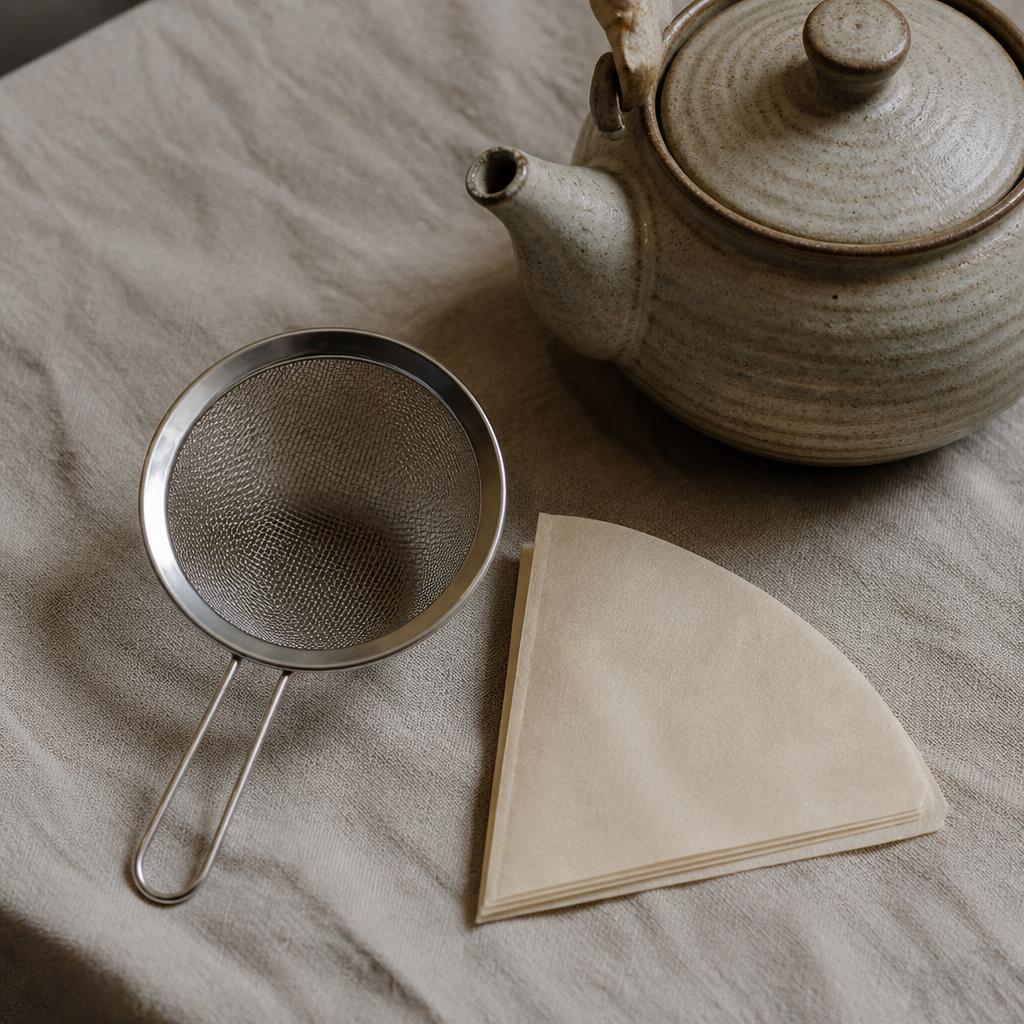
Paper or metal filter, which should you choose for brewing?
Written by Dian VAULTIER·
In Brief
- The choice of filter is never insignificant when preparing tea: it directly determines which substances from the leaf reach the cup.
- The metal filter, generally made of stainless steel, has a mesh wide enough to allow the leaf's volatile essential oils to pass through, carrying a large sha…
- The HOLLIN sommelier's expertise: paper or metal filter, which to choose for brewing, explained by a purist Tea House, with no added flavourings, based in Sartrouville (Île-de-France) and shipping its grand crus worldwide.
The choice of filter is never insignificant when preparing tea: it directly determines which substances from the leaf reach the cup. The metal filter, porous and inert, allows the essential oils responsible for the aromatic bouquet to circulate. The finer paper filter retains more particles and lipid compounds. This technical choice should be adapted to each family of tea to reveal its full potential.
What each material actually filters
The metal filter, generally made of stainless steel, has a mesh wide enough to allow the leaf's volatile essential oils to pass through, carrying a large part of the aromatic bouquet. This relative porosity produces a more textured liquor with a richer mouthfeel.
The paper filter, by contrast, acts as a finer barrier that retains fine leaf particles, tea dust residue and some of the aromatic lipids. The resulting liquor is visually clearer, but sometimes perceived as slightly less rounded.
Adapting the filter to the family of tea
For grand crus of green tea, ofoolong or of white tea, where aromatic richness is the main source of sensory appeal, the metal filter or thetime loose-leaf infusion without a filter, in a gaiwan teapot for example, allows the terroir its fullest expression.
For black teas full-bodied or the herbal teas consumed quickly on a daily basis, the paper filter offers welcome practical convenience, without significantly altering the experience, as the tannic structure of these teas is less dependent on delicate volatile oils.
Care and durability
A quality metal filter, if rinsed and dried after each use, can accompany years of tasting without noticeable deterioration. It is also a more sustainable choice, reducing the waste associated with disposable filters.
A single-use paper filter should be chosen unbleached with chlorine to avoid any chemical interference with the tea's delicate aromas, particularly for the herbal teas the finest.
The purist selection of HOLLIN
At the HOLLIN du Goût counter, 22 avenue de la République, 78500 Sartrouville, open Monday to Saturday from 10h to 20h, we offer a selection of fine-mesh stainless steel infusers, chosen for their compatibility with all of our teas whole-leaf.
Our teams will advise you on the accessory best suited to your ritual, whether an individual teapot for the office or a complete set for tasting with the family.
What the filter does to the liquor
A filter is not simply a tool for cleanliness, it is an interface. Paper, fibrous and porous, retains some of the essential oils and fine particles, producing a crisp, clear liquor, sometimes with slightly less texture. Metal, generally fine-mesh stainless steel, allows more colloids to pass through and delivers a richer, fuller mouthfeel, at the cost of a slight haze in the cup.
Volume matters just as much as material. A narrow tea ball compresses the leaf, prevents it from unfurling and produces a time unbalanced, weak in aroma and strong in bitterness. A wide basket, occupying half the volume of the teapot, allows the leaf to breathe, which remains the most decisive variable in the result.
Choosing according to the tea and its use
For green teas Japanese, whose particles are fine and numerous, unbleached paper or a very fine mesh prevents sediment. For oolongs rolled and large black teas with whole leaves, the wide metal basket is preferable: it supports the unfurling of the leaf and preserves the aromatic substance. Finally, compressed dark teas are compatible with any filter, provided the leaves are briefly rinsed before the first time.
Care determines the filter's longevity. Metal should be rinsed immediately with hot water, without soap, and left to air-dry to prevent the film of tannin that flavours the herbal teas subsequent ones. Paper is discarded with the leaf, simplifying the morning ritual but leaving an ecological footprint to consider. A durable filter, chosen from our selection of objects for tea, remains the most faithful compromise over time.
To continue this exploration beyond the screen, step through the door of the HOLLIN du Goût counter, our contemporary Asian grocery located at 22 avenue de la République in Sartrouville. Here, the leaves are opened, smelled and discussed, and every recommendation is tailored to your water, your teapot and your time of day.
Frequently Asked Questions (FAQ)
- Does a metal filter give tea a metallic taste?
- A quality stainless steel filter, properly rinsed, does not alter the taste of the tea. The risk of a metallic note arises mainly with lower-quality or poorly maintained materials. Choose certified food-grade stainless steel for complete neutrality.
- Can loose-leaf tea be brewed without any filter?
- Yes, it is even the traditional method with a gaiwan teapot or an earthenware teapot fitted with an integrated filtering spout. This approach allows maximum extraction of essential oils, particularly suited to oolongs and the grand crus of green tea.
- What mesh size should be chosen for a metal filter?
- A fine mesh, around 0,3 to 0,5 millimetre, is suitable for most whole-leaf teas and effectively retains fragments while allowing essential oils through. For very broken teas such as certain CTC teas, a finer mesh prevents particles from passing into the cup.