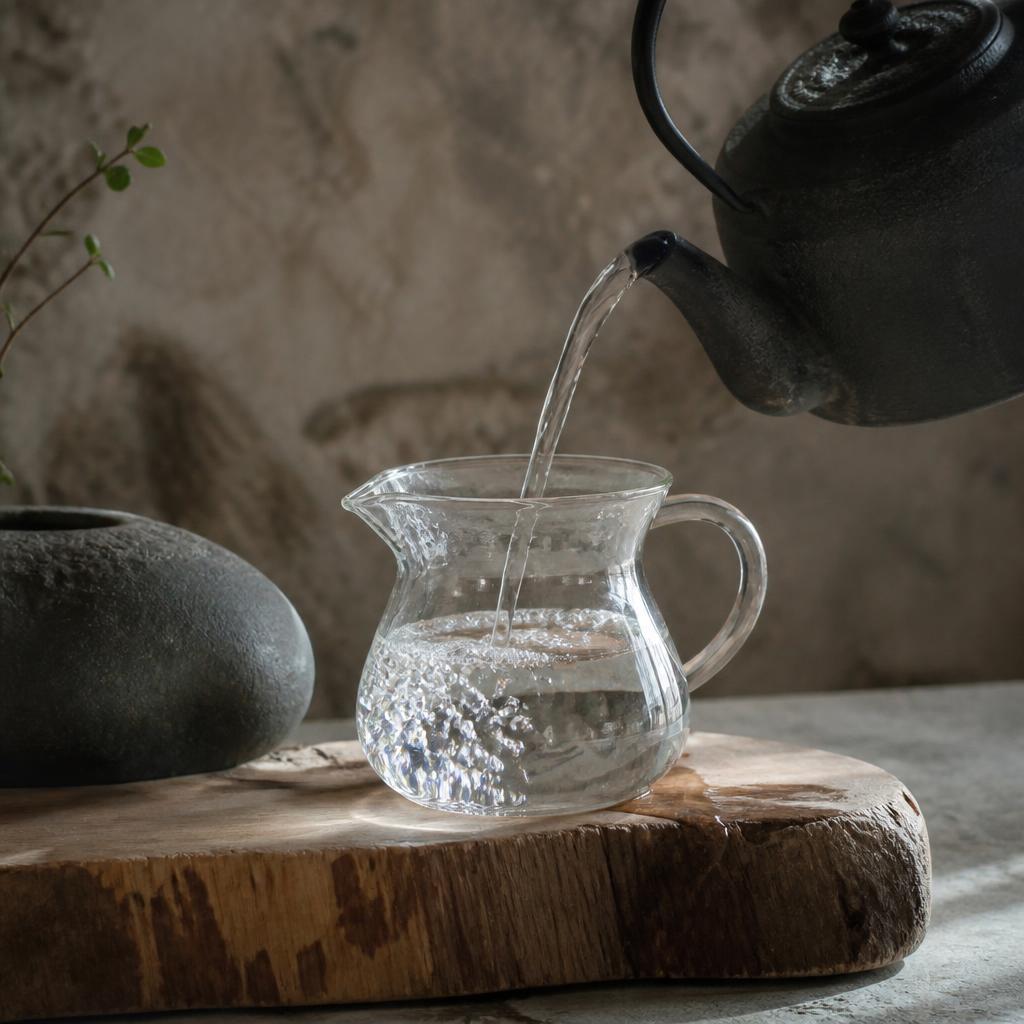
Which water should you choose to prepare your tea?
Written by Dian VAULTIER·
In Brief
- Water makes up nearly 99% of the brewed cup and is never a neutral medium.
- Water acts as a solvent for the leaf's water-soluble compounds: catechins, caffeine, amino acids and polyphenols.
- The expertise of the HOLLIN sommelier: which water to choose to prepare your tea, explained by a purist Tea Maison, with no added flavourings, based in Sartrouville (Île-de-France) and shipping its fine teas worldwide.
Water makes up nearly 99% of the brewed cup and is never a neutral medium. Its mineral content, pH and chlorine level interact directly with the catechins and volatile compounds of the tea. Poorly chosen water can mask a fine tea as surely as a time too long. Understanding this water chemistry is the first step towards rigorous tasting.
The biochemical role of water in extraction
Water acts as a solvent for the leaf's water-soluble compounds: catechins, caffeine, amino acids and polyphenols. Its mineral composition alters the speed and intensity of this extraction. Water with a high dry residue, rich in calcium and magnesium, binds with polyphenols and clouds the liquor, while water that is too pure can, conversely, accentuate poorly controlled astringency.
pH also influences the residual oxidation of phenolic compounds in the cup. Slightly acidic to neutral water, between 6.5 and 7.5, promotes aromatic stability and prevents flat or metallic notes from developing.
Which water to favour for each family of tea
For green teas Japanese teas and oolongs delicate teas, water with low mineral content and a dry residue below 50 mg/L preserves the finesse of vegetal and umami notes. For black teas and heavily oxidised oolongs, slightly higher mineral content can, conversely, support the body of the liquor without overwhelming it.
Tap water, often chlorinated and hard depending on the region, is not recommended without prior filtration. A filter jug or low-mineral spring water offers a reliable compromise for most teas.
Temperature and mineral content: a connected equation
The mineral content of water cannot be considered independently of the temperature oftime. Water heated at a prolonged boil loses its dissolved oxygen, which flattens the aromas regardless of its initial purity. The water should therefore be heated just before brewing, without boiling it several times.
For a white tea or a Gyokuro, water between 60 and 70 degrees Celsius, combined with low mineral content, allows the sweet amino acids to be extracted slowly and progressively, without prematurely releasing the bitter tannins.
The purist selection of HOLLIN
At the HOLLIN du Goût counter, 22 avenue de la République, 78500 Sartrouville, open Monday to Saturday from 10h to 20h, we accompany every recommendation on water with a comparative tasting. Our tea masters show you, glass in hand, how the same leaf takes on a different character depending on the water used, so that you can reproduce the experience precisely at home.
This educational approach applies across all our ranges, from the green teas Japanese teas to oolongs from Taiwan, and makes it possible to adjust not only the water but also the time oftime and the teapot best suited to your daily practice.
Minerality, that invisible ink
A cup of tea is more than ninety-nine percent water. What we call the taste of tea is therefore, to a large extent, the taste of water revealed by the leaf. Calcium and magnesium ions, the presence of bicarbonates and the sodium content form a flavour framework upon which the leaf's compounds are inscribed. Highly mineralised water hardens the tannins, thickens the texture and flattens the high notes. Water that is too low in minerals, conversely, leaves the tea adrift, without depth or length.
Tasters generally seek a dry residue of between thirty and one hundred and twenty milligrams per litre, with low carbonate hardness. This range allows amino acids, including theanine, the space to express their sweetness, while giving the polyphenols a clear structure. This is the balance we seek for our green teas spring teas as well as for the great classics in our green tea collection.
Temperature, oxygen and the right gestures
Water boiled for a long time loses its dissolved oxygen and produces a dull liquor. It is preferable to heat freshly drawn water and stop at the first simmer for delicate teas, around seventy to eighty degrees, reserving one hundred degrees for dark teas and herbal teas of plants. A thermometer is useful for the first few weeks, then the ear and eye take over: the song of the kettle always precedes a rolling boil.
A domestic carbon filter effectively reduces chlorine and some of the hardness, without claiming to transform very hard water. In hard-water regions, low-mineral spring water remains the simplest option. Lastly, regularly rinsing limescale deposits from the kettle prevents a mineral film from clouding the clarity of the liquor day after day.
To continue this exploration beyond the screen, step through the door of the HOLLIN du Goût counter, our contemporary Asian grocery located at 22 avenue de la République in Sartrouville. Here, the leaves are opened, smelled and discussed, and every recommendation is tailored to your water, your teapot and your time of day.
Frequently Asked Questions (FAQ)
- Should bottled water be used to brew a quality tea?
- It is not essential, but low-mineral bottled water makes consistent results easier to achieve. Check the dry residue indicated on the label: a value below 50 mg/L is suitable for most green teas and white teas, while moderate mineral content better supports the black teas full-bodied teas.
- Does tap water really impair the taste of tea?
- The chlorine and limescale present in some tap water react with the tea’s polyphenols, creating flat or metallic notes. Simple filtering with a water filter pitcher greatly reduces these interferences and restores greater aromatic clarity, without requiring a costly investment.
- Can water that has already been boiled be reused for another brew?
- It is best to avoid reboiling the same water several times: dissolved oxygen decreases with each cycle, diminishing the aromatic expression of thetime. Use freshly drawn water for each preparation to preserve the vibrancy of the tea’s aromas.