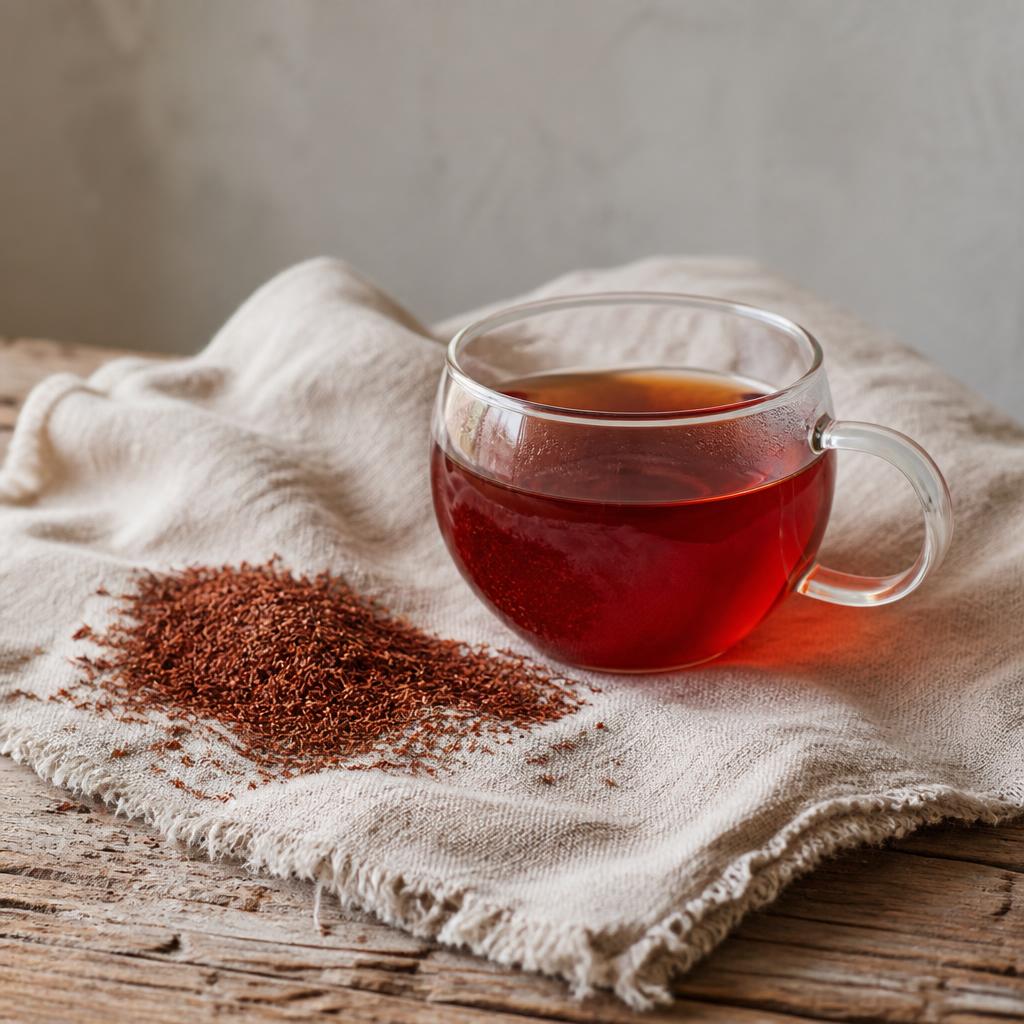
Is rooibos really tea?
Written by Dian VAULTIER·
In Brief
- Rooibos is commonly called red tea, and this designation is botanically incorrect.
- Tea comes exclusively from Camellia sinensis, a shrub in the Theaceae family, native to south-western China and northern Burma.
- The expertise of the HOLLIN sommelier: is rooibos really tea, decoded by a purist Tea House, with no added flavourings, based in Sartrouville (Île-de-France) and shipping its grand crus worldwide.
Rooibos is commonly called red tea, and this designation is botanically incorrect. It comes from Aspalathus linearis, a legume endemic to South Africa, entirely unrelated to Camellia sinensis. The distinction is not specialist pedantry: it determines its composition, its effects and the correct way to prepare it.
Two plants, two distinct botanical families
Tea comes exclusively from Camellia sinensis, a shrub in the family of Teaaceae, native to south-western China and northern Burma. Every family of tea, green, white, yellow, Oolong, black and dark, comes from this single species; only processing distinguishes them.
Rooibos belongs to Aspalathus linearis, a member of the Fabaceae, that is, a legume related to peas and beans. It grows almost exclusively in the Cederberg region, north of the Cape, on poor, sandy soils, in a climate marked by wide temperature variations.
Its needle-shaped stems and leaves are therefore harvested, chopped, then, for red rooibos, oxidised in the open air before drying. Green rooibos skips this oxidation stage: it retains a vegetal, more herbaceous profile, and a significantly higher concentration of phenolic compounds.
Zero caffeine, very few tannins: two decisive differences
Rooibos contains no caffeine, unlike any tea derived from Camellia sinensis, including so-called decaffeinated teas, which retain traces of it. This total, rather than partial, absence makes it the quintessential hot drink for the end of the day, with no impact whatsoever on falling asleep.
Its tannin content is very low, approximately one tenth that of a black tea. Two practical consequences follow: rooibos never becomes bitter, even after a time prolonged, and it has virtually no effect on the absorption of non-haem iron, unlike tea.
Its characteristic compounds are unique to it: aspalathin and nothofagin, two antioxidant dihydrochalcones found in no other plant consumed by humans. Green, unoxidised rooibos contains significantly more than red rooibos, as oxidation transforms some of the aspalathin.
Preparation: forget the rules of tea
Rooibos requires water at a full boil, 100 degrees, and a time long, from seven to ten minutes. The delicate protocols of green tea make no sense here: the absence of free tannins eliminates any risk of bitterness, and an infusion that is too short simply yields a weak, bodiless drink.
Allow 3 to 4 grams for 250 millilitres of water. Rooibos pairs perfectly with milk, a common practice in South Africa, as well as spices: cardamom, cinnamon, ginger. It also makes an excellent base fortime iced, its natural sweetness requiring no added sugar.
A word on its commercial designation: rooibos sold as red tea creates confusion with Chinese hong cha, literally red tea, which refers to what the West calls black tea and which does indeed come from Camellia sinensis. Two entirely unrelated products thus share the same common name.
When to choose rooibos, when to choose tea
Rooibos is the clear choice in four situations: in the evening, during pregnancy or breastfeeding, for children, and in cases of documented iron deficiency. In each instance, the absence of caffeine and tannins that inhibit absorption is an objective advantage that no tea can match.
However, it does not replace tea on a sensory level. Its aromatic palette, with notes of soft wood, vanilla, honey and dried fruit, is genuine but limited in scope. It offers neither the evolving complexity of a Oolong over eight herbal teas, nor the umami depth of a green tea shaded Japanese.
The purist selection of HOLLIN
We list rooibos and the herbal teas for what they are, without selling them as teas. The same standards apply: pure ingredients, an even cut, no added artificial flavouring, and every batch tasted before being offered.
To compare a red rooibos and a green rooibos side by side, visit the HOLLIN du Goût counter, 22 avenue de la République, 78500 Sartrouville, Monday to Saturday from 10h to 20h. The difference between the two surprises most visitors.
Frequently Asked Questions (FAQ)
- Does rooibos really contain zero caffeine, or merely very little?
- Zero, in the strictest sense. Aspalathus linearis does not synthesise caffeine, unlike Camellia sinensis. The distinction is important when compared with decaffeinated tea, which retains approximately 2 to 5 milligrams of residual caffeine per cup after processing. Rooibos is therefore suitable without reservation in the evening, for children, and during pregnancy.
- Can rooibos be left to infuse too long and become bitter?
- Virtually none. Its free tannin content is approximately ten times lower than that of a black tea, which eliminates the mechanism of astringency caused by the precipitation of salivary proteins. An time of fifteen minutes produces a fuller-bodied, woodier drink, but not a bitter one. The most common mistake, by contrast, remains an infusion that is too short.
- What is the difference between red rooibos and green rooibos?
- Oxidation, exactly as with tea, but using a different plant. Red rooibos is oxidised in the open air after chopping, which develops notes of soft wood, honey and vanilla. Green rooibos skips this stage: its profile remains herbaceous and livelier, and it retains a significantly higher concentration of aspalathin, the antioxidant molecule characteristic of the species.