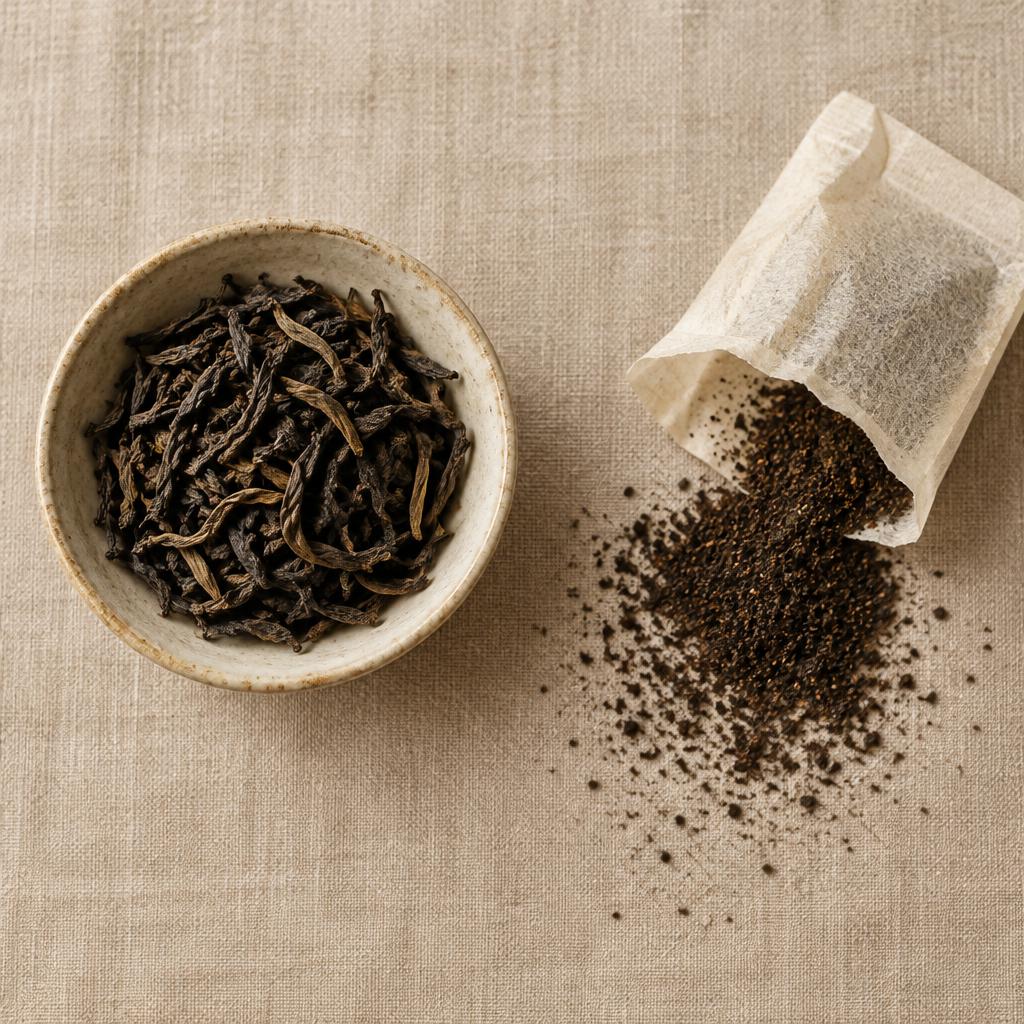
Loose-leaf tea or tea bags: what is the difference?
Written by Dian VAULTIER·
In Brief
- The difference between loose-leaf tea and tea bags is not just about packaging.
- Most standard tea bags contain fannings or dust, the smallest grades in leaf classification.
- HOLLIN tea sommelier expertise: loose-leaf tea and tea bags explained by a purist Tea House specialising in pure teas, based in Sartrouville (Île-de-France) and shipping its finest teas worldwide.
The difference between loose-leaf tea and tea bags is not just about packaging. It begins with the leaf: whole on one side, most often broken on the other. This size governs theextraction, the balance between aromas and tannins, and therefore the entire liquor. Here is what really changes in the cup.
Whole leaves versus fragments
Most standard tea bags contain fannings or dust, the smallest grades in leaf classification. These fragments offer an immense contact surface: extraction is rapid, and colour appears within seconds.
The question of aromas
Volatile aromatic compounds escape more quickly from a fragment than from a rolled leaf. Broken tea therefore loses some of its fragrance between production and the cup. Loose-leaf tea, stored in an airtight tin, better protects these fragile molecules, as well as the L-Theanine responsible for sweetness.
The choice of container matters: an opaque tin, protected from air, light and moisture. This is why our green teas are offered in metal tins.
Infusion space and leaf expansion
A whole leaf can triple or quadruple in volume as it absorbs water. Confined in a small tea bag, it cannot unfurl and infuses poorly. Loose-leaf tea, in a teapot or a large filter, allows the leaf to open freely.
A quick comparison:
- taste: a broader, more nuanced palette with loose-leaf tea;
- reinfusion: two to six herbal teas with loose-leaf tea, only one with a standard tea bag;
- speed: advantage to the tea bag;
- cost per cup: often comparable, or even lower for loose-leaf thanks to reherbal teas.
Environmental impact and materials
Some pyramid tea bags are made from nylon or PLA. A study reported on PubMed showed that a plastic tea bag steeped at 95 °C releases billions of microparticles. Paper tea bags are often sealed with a synthetic fibre.
Loose-leaf tea produces only compostable leaves and a reusable container. This is one more reason to favour whole leaves every day.
When tea bags have their place
Tea bags remain convenient at the office or when travelling. A tea bag filled with whole leaves, made from unbleached paper, offers a good compromise. For a black tea robust morning tea, a quality broken-leaf grade produces a bold cup, ideal with a splash of milk. Our black teas are designed for this versatility.
The key is to read the label:origin, grade, harvest date. A oxidation controlled process and an identifiable leaf remain the best guarantees of quality.
Measuring loose-leaf tea correctly
Loose-leaf tea requires one extra step: measuring. Allow an average of 2 to 3 g for 200 ml, or one heaped teaspoon for dense leaves and two for voluminous leaves such as white teas,. A kitchen scale accurate to the gram makes consistency easier.
Useful accessories:
- a teapot with a wide filter, so the leaf can unfurl;
- a gaiwan for herbal teas short and repeated infusions;
- a airtight container opaque for storage;
- a timer to follow the timings.
With these tools, loose-leaf tea becomes as simple as tea bags, while offering complete control over the liquor. The dose can be adjusted according to the time of day and the desired intensity.
Freshness and storage
A loose-leaf tea of quality often indicates its harvest date. The green teas are best enjoyed within the year, the black teas and rolled oolongs roasted ones keep longer, and some pu'erh even improve with age. Tea bags, by contrast, rarely specify the harvest.
The main enemy is oxygen. A oxidation slow process continues after production and degrades the L-Theanine, volatile aromas and vegetal freshness. A tightly closed container, stored away from heat and strong odours, limits this phenomenon.
Avoid the refrigerator for everyday use: temperature fluctuations create condensation, which is highly damaging to dry leaves.
Comparing in the cup at the counter
At HOLLIN taste counter, our contemporary Asian grocery store in Sartrouville, we are happy to prepare the same origin as whole leaf and in a broken-leaf grade, side by side. Three minutes are enough to taste the difference. You leave with the leaf that suits your pace.
Dian VAULTIER, for HOLLIN.
Frequently Asked Questions (FAQ)
- Is loose-leaf tea better than tea bags?
- Most often, yes, because it contains whole leaves that release their aromas gradually and can be reinfused. A whole-leaf tea bag can nonetheless be of good quality.
- Do tea bags contain plastic?
- Some pyramid bags are made of nylon or PLA, and many paper bags are sealed with a synthetic fiber. Check the composition.
- Is loose-leaf tea more expensive?
- Not necessarily. Since the same leaves can be infused several times, the cost per cup is often equivalent or lower.