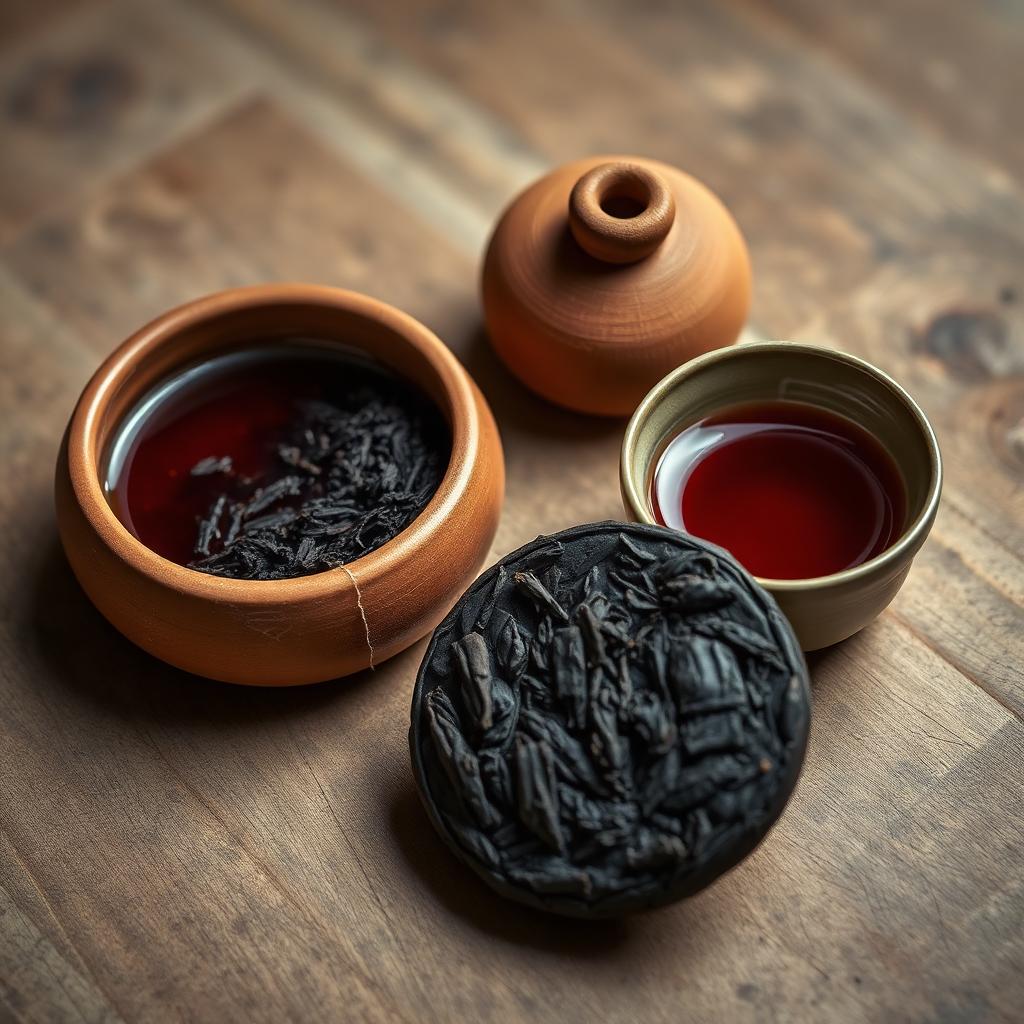
What is Pu-erh tea (dark tea)? Sheng, shou and ageing
Written by Dian VAULTIER·
In Brief
- Pu-erh is a dark tea from Yunnan, defined by microbial post-fermentation rather than simple enzymatic oxidation.
- Black tea, called red tea in China, results from enzymatic oxidation driven by the leaf's own enzymes, polyphenol oxidase, to a level close to 100 per cent.
- HOLLIN sommelier expertise: what is Pu-erh tea (dark tea), explained by a purist Tea House, with no added flavourings, based in Sartrouville (Île-de-France) and shipping its grand crus worldwide.
Pu-erh is a dark tea from Yunnan, defined by microbial post-fermentation rather than simple enzymatic oxidation. After the leaf's initial fixation, micro-organisms, mainly Aspergillus and yeasts, slowly transform the polyphenols into heavier compounds. It is the only major tea whose profile truly improves over several decades when storage conditions are carefully controlled.
Post-fermentation: what distinguishes Pu-erh from black tea
The black tea, called red tea in China, results from enzymatic oxidation driven by the leaf's own enzymes, polyphenol oxidase, to a level close to 100 per cent. The process is then stopped by heat, and the resulting tea is a finished product that will slowly deteriorate.
Pu-erh follows a different path. The leaf is first heat-fixed, but deliberately incompletely, leaving residual enzymatic activity and a microbial flora. This flora then takes over: it metabolises catechins into theabrownins, develops organic acids and produces the characteristic earthy, woody and camphoraceous notes.
This difference in mechanism explains everything else: its ageing potential, the evolution of its profile over time, and its compressed cake form, which limits gas exchange and slows the transformation to a controlled pace.
Sheng and shou: two opposing timelines
The most important distinction for a buyer is between raw Pu-erh and ripe Pu-erh. It concerns not quality but the process and therefore the expected profile.
Sheng, or raw Pu-erh
Sheng is compressed shortly after fixation and left to age naturally. When young, it is lively, astringent, highly floral, sometimes distinctly aggressive: its concentration of free catechins is still high. After ten to twenty years of storage, these catechins have polymerised, the astringency has given way to a profound sweetness and notes of undergrowth, leather and camphor.
This is the format sought by collectors, as it retains an open trajectory. A well-preserved sheng, kept at stable humidity and away from odours, continues to evolve for several decades.
Shou, or ripe Pu-erh
Shou was created in 1973 at the Kunming factory, in response to an industrial need: to reproduce the character of an aged tea in just a few weeks. The technique, known as wo dui, consists of moistening and piling the leaves in heaps for forty to sixty days, under controlled temperature and humidity, to dramatically accelerate microbial activity.
The result is immediately drinkable: dark liquor, thick texture, notes of damp earth, wood and sometimes mushroom, with virtually no astringency. A shou continues to evolve slightly in storage, but far less than a sheng, as most of its transformation has already taken place.
Brewing and storing Pu-erh properly
Pu-erh tolerates, and even calls for, hot water: 95 to 100 degrees. Gently loosen the leaves from the cake with a Pu-erh knife, preserving their integrity. Use 5 grams per 100 milliliters for gong fu cha. The first, very brief pour serves as a rinse: it awakens the compressed leaf and removes storage dust.
Then follow with herbal teas from 10 to 20 seconds, gradually increasing the time. A good shou yields ten to fifteen infusions, an old sheng sometimes more. A porous Yixing clay teapot softens the edges of a young sheng, but a porcelain gaiwan remains more faithful for evaluating a batch.
For storage, forget the refrigerator and airtight containers: Pu-erh needs to breathe. A dry, ventilated place, at a stable temperature, between 20 and 25 degrees, and above all away from any strong odour, as the cake absorbs its environment. A humidity level of 60 to 70 per cent is the generally accepted compromise.
The purist selection of HOLLIN
The Pu-erh market is one of the most opaque in the tea world: relabelled vintages, unverifiable origins, accelerated storage in damp cellars that leaves mouldy notes passed off as a style. Our method remains the same as for our entire collection: we taste every batch before listing it and reject teas whose history cannot be verified.
None of our teas receives no added flavouring, and Pu-erh less than any other: its complexity is the product of time and microbial flora, never of an addition. To continue this exploration, a comparative tasting of a young sheng and a mature shou is offered at the HOLLIN du Goût counter, 22 avenue de la République, 78500 Sartrouville, Monday to Saturday from 10h to 20h.
Frequently Asked Questions (FAQ)
- Can a Pu-erh really be kept for several decades without spoiling?
- Yes, provided that storage is dry, ventilated and stable in temperature. Compression into a cake limits the surface area exposed to air and slows the transformation, while the microbial flora slowly continues its work. Excessive humidity, however, causes the tea to develop undesirable mould, and a distinctly pungent cellar smell is a sign of poor storage, not nobility.
- How can you distinguish an aged raw Pu-erh from a recent ripe Pu-erh when tasting?
- Texture and finish clearly set them apart. An aged sheng retains a residual liveliness, a noble bitterness that turns into sweetness on the finish, and an amber rather than black liquor. A recent shou delivers a very dark liquor, immediate roundness, notes of damp earth and a shorter finish, without the characteristic returning sweetness of aged raw tea.
- Should Pu-erh really be rinsed before drinking, and does doing so lose aromas?
- A rinse of three to five seconds is recommended for compressed leaves: it rehydrates the cake, opens the leaves and removes storage particles. Aromatic loss is negligible at this duration, as extraction has barely begun. For a well-aerated young sheng, a shorter rinse is sufficient, and some tasters omit it to lose nothing of the first floral infusion.