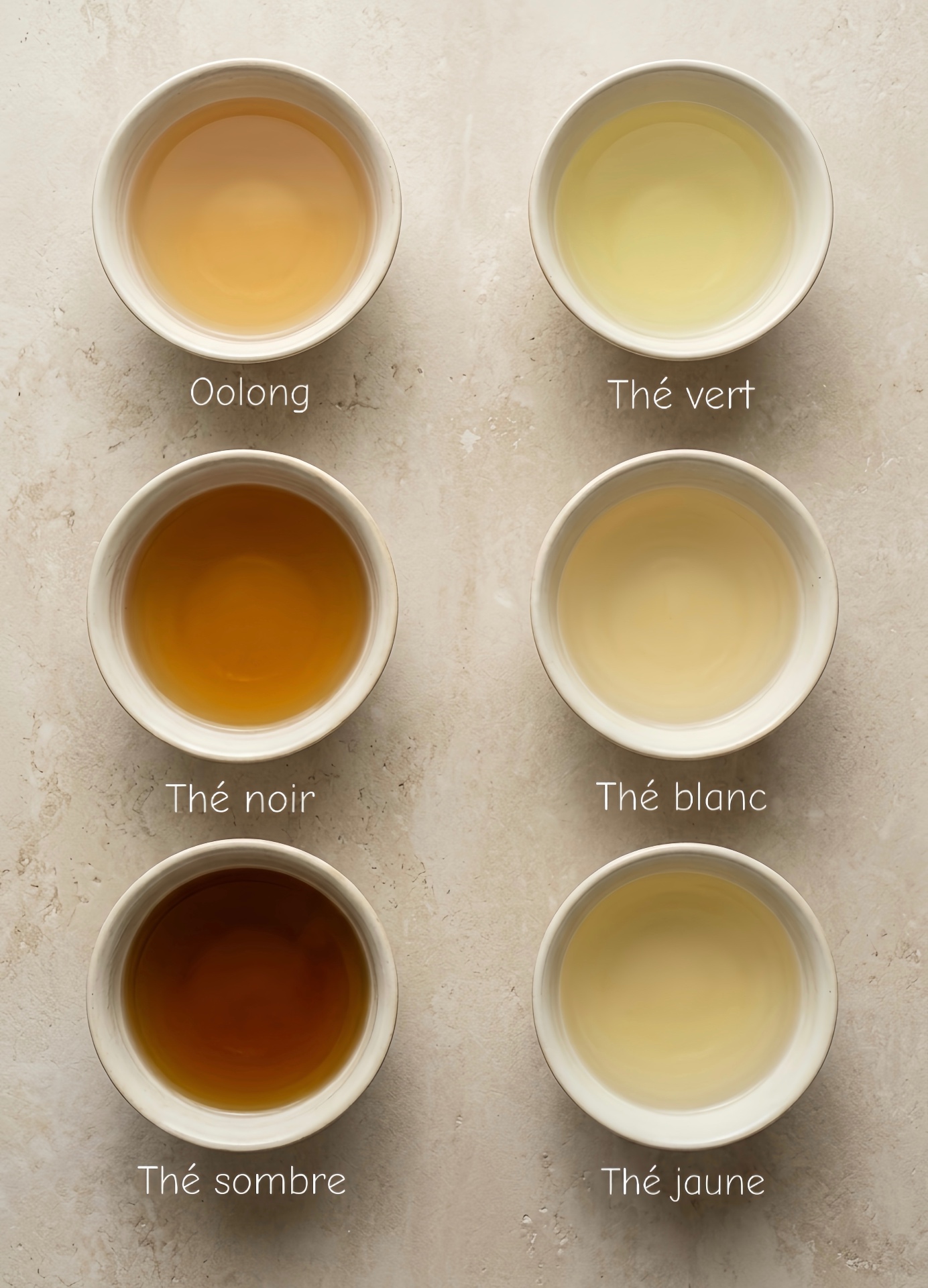
Difference between white tea and black tea: a question of oxidation
Written by Dian VAULTIER·
In Brief
- Everything begins with the same leaf. White tea and black tea are not two different plants, but two states of the same living material, separated by a single phenomenon: oxidation e…
- White tea, green tea, oolong, black tea: these families do not refer to distinct botanical species.
- The expertise of the HOLLIN sommelier : the difference between white tea and black tea explained by a purist Tea Maison, without added flavorings, based in Sartrouville (Île-de-France) and shipping its grand crus worldwide.
Everything begins with the same leaf. The white tea and the black tea are not two different plants, but two states of the same living material, separated by a single phenomenon: enzymatic oxidation. To understand this shift is to understand why a well-crafted leaf needs no added flavorings.
A single plant of origin: Camellia sinensis
White tea, green tea, oolong, black tea: these families do not refer to distinct botanical species. They all come from Camellia sinensis, a shrub of the Theaceae family grown fromAssam to Fujian, from Hunan to Japan. What distinguishes one family from another is the human craft applied to the leaf after plucking: withering, fixation, rolling, drying.
At the heart of these gestures is an enzyme, polyphenol oxidase, present in the leaf itself. As long as the cell remains intact, it sleeps. As soon as the cell wall is broken or the leaf loses its water upon contact with the air, the enzyme comes into contact with the catechins and triggers oxidation. Producers create nothing: they accelerate, slow down or stop this natural process.
If you are discovering these families, the overall picture is explained step by step in our article Understanding tea, simply. It introduces the vocabulary before going into the chemical details.
White tea: the art of non-intervention
The white tea is the leaf in its rawest state. After fine plucking, often limited to the bud and the first leaf still covered in silvery down, the material is simply withered in the open air and then dried. No rolling, no abrupt fixation, no roasting. Intervention is limited to controlling humidity, ventilation and duration.
This apparent simplicity is in fact the most demanding discipline. Light oxidation, in the order of a few percent, develops naturally during withering. The producer must guide it without ever allowing it to run away. The result is a pale, almost crystalline liquor, with notes of white flower, fresh melon, soft hay and raw almond, with a sweetness that lingers on the palate.
The great classics of this family, Silver Needle composed solely of buds or the more floral white flower-style blends, show just how fully the leaf can unfold an entire palette without any addition. It is the clearest demonstration of the HOLLIN approach: nothing to perfume, everything to reveal.
Black tea: mastering complete oxidation
The black tea, called red tea in China because of the color of its liquor, follows the opposite path. After withering, the leaf is rolled, sometimes mechanically kneaded, to break the cell walls and release the juices. The enzyme then encounters oxygen on a massive scale. In a few hours, in a warm and humid room, oxidation reaches nearly one hundred percent.
The transformation is chemical and profound. Green catechins condense into theaflavins and then thearubigins, molecules responsible for the amber color and tannic roundness. The volatile compounds change too: notes of cooked fruit, dark honey, cocoa and damp wood emerge, along with, depending on the final drying, pyrogenic accents of toast or wood fire. The leaf is then dried to permanently fix the state achieved.
This spectrum is so broad that it makes artificial flavoring unnecessary. Between a white tea barely touched and a black tea fully oxidized lies an infinity of nuances, achieved solely through time, temperature and humidity. This is precisely why HOLLIN works only with pure tea: mastery of oxidation is sufficient in itself.
Which pure HOLLIN tea to choose for each moment?
The white tea calls for a meditative state. Its low astringency, richness in amino acids and light liquor make it the companion of slow mornings, quiet late afternoons and moments of reading. Steep it at around 80 degrees, for three to four minutes, and allow the cup to cool slightly before the first sip.
The black tea gives structure to the day. Its tannic strength, lingering finish and amber liquor complement breakfast, the return to the morning or a pairing with a lightly sweetened pastry. Water at 90 degrees for three minutes is enough to draw out its best qualities without bitterness.
Frequently Asked Questions (FAQ)
- Does white tea contain theine?
- Yes. The white tea contains theine, which is the same molecule as caffeine. Its content is even often high, as the silvery buds used for great white teas naturally concentrate the plant's caffeine. The sensation nevertheless remains gentler than that of a black tea, because the L theanine and low astringency of the liquor temper its effect and spread it over time.
- Can white tea be infused like black tea?
- It is not recommended. A black tea withstands water at 90 degrees for three minutes, as its complete oxidation has already stabilized it. A white tea infused in water this hot loses its floral notes and becomes flat. Aim for 80 degrees and three to four minutes, or use herbal teas short and successive to observe how the leaf evolves from cup to cup.
- Which has the stronger flavour, white tea or black tea?
- The black tea is more powerful in its immediate intensity: amber liquor, tannic body, notes of cooked fruit and wood. The white tea is more restrained at first, but often longer on the finish, with persistent sweetness and great aromatic finesse. Power and quality are not synonymous: a subtle white tea can be far more complex than an assertive black tea.