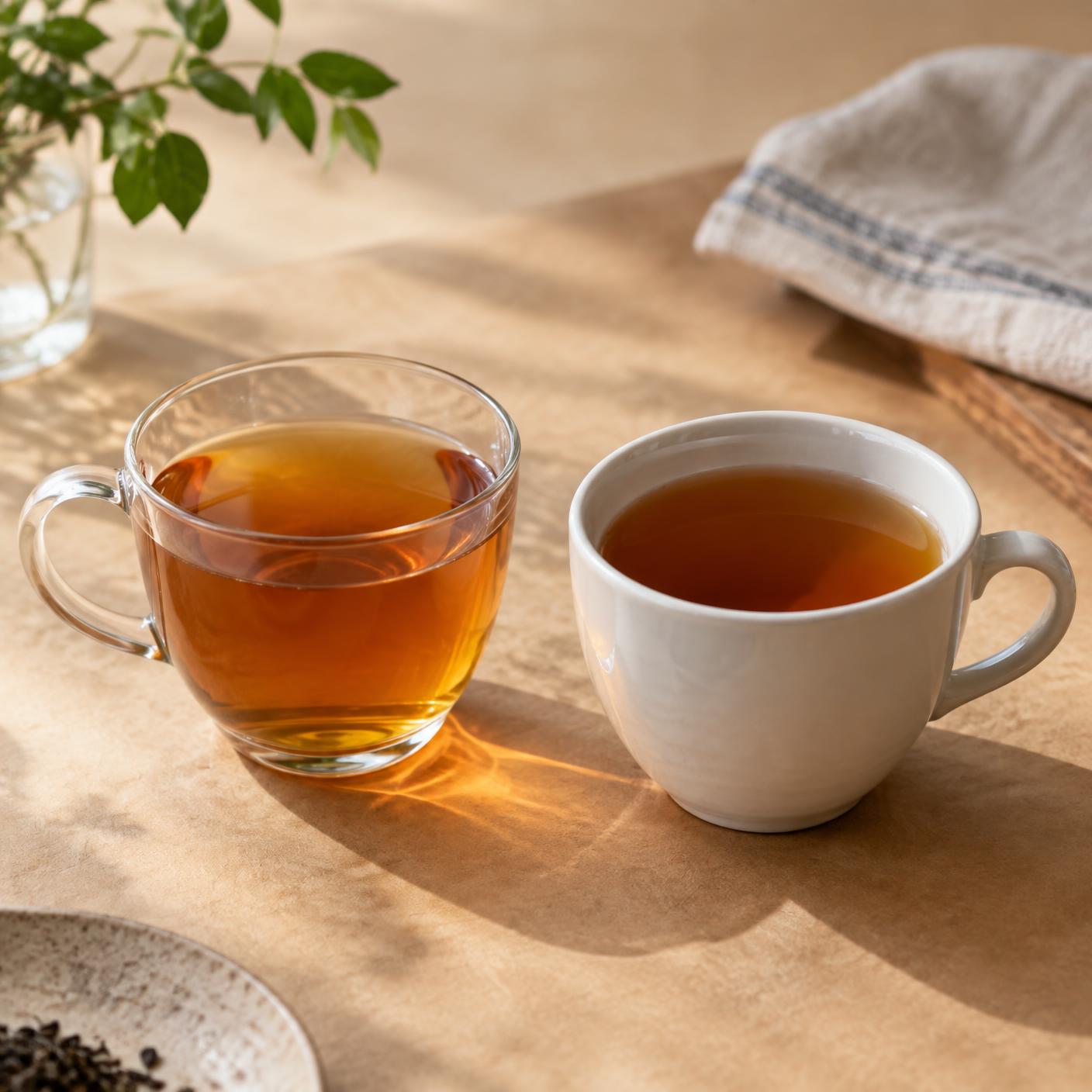
Glass or porcelain cup: which should you choose?
Written by Dian VAULTIER·
In Brief
- The choice of tasting vessel, often relegated to the background, nevertheless influences the sensory perception of tea just as much as the glass chosen for wine.
- Porcelain, a vitrified and non-porous material, does not chemically interfere with the aromatic compounds in tea, ensuring a faithful expression of the flavour profile from one serving to…
- HOLLIN sommelier expertise: glass or porcelain cups explained by a purist Tea House, offering no added flavourings, based in Sartrouville (Île-de-France) and shipping its fine teas worldwide.
The choice of tasting vessel, often relegated to the background, nevertheless influences the sensory perception of tea just as much as the glass chosen for wine. Porcelain and glass, both inert materials, nevertheless differ in their thermal properties and in the visual dimension they may or may not offer. An informed choice of vessel complements the same rigour applied to water and steeping timetime.
Porcelain: neutrality and heat retention
Porcelain, a vitrified and non-porous material, does not chemically interfere with the aromatic compounds in tea, ensuring a faithful expression of the flavour profile from one serving to the next. Its relatively thick walls also offer good heat retention, keeping the liquor at tasting temperature for longer.
This characteristic makes it a preferred choice for professional comparative tastings, where the consistency of the vessel ensures that only the tea itself is assessed, without extraneous variables.
Glass: transparency and sensory observation
Glass, which is also inert, offers an advantage that porcelain cannot match: complete visibility of the liquor and, in the case of a glass teapot, of the unfurling leaves during thetime. This visual dimension enriches the tasting experience, particularly for teas whose colour changes noticeably, such as rolled oolongs or flower teas.
Its thinner walls do, however, cool the liquor more quickly, which may suit teas enjoyed warm or cold, but less so teas that require a stable temperature for longer.
Which vessel for each tea family
For white teas and rolled oolongs light, whose pale hue and delicate unfurling deserve to be observed, a thick-walled, double-bottomed glass offers an excellent balance between visibility and moderate heat retention.
For black teas and complex grand crus savoured slowly, a cup made of fine porcelain, possibly preceded by sampling from a dedicated aroma cup, allows for optimal appreciation of aroma and flavour over time.
The purist selection of HOLLIN
Our HOLLIN du Goût counter, 22 avenue de la République, 78500 Sartrouville, open Monday to Saturday from 10h to 20h, offers a selection of fine porcelain and blown-glass tea sets, chosen for their neutrality and suitability for our different families of teas.
Our advisers can help you create a tea service suited to your tasting practice, whether it is practical and for everyday use or dedicated to moments of deeper contemplation.
Frequently Asked Questions (FAQ)
- Does glass alter the taste of tea compared with porcelain?
- No, glass is a chemically inert material, just like vitrified porcelain. The perceived difference stems mainly from the rate of cooling, which is faster in glass, and not from a chemical interaction with the tea’s compounds.
- Why do some professionals use white cups for tasting?
- White porcelain, without patterns or colour, makes it possible to accurately assess the liquor’s true hue, an important criterion in professional sensory analysis of tea. Any colour in the vessel would distort the visual perception of the tea’s appearance.
- Is a glass teapot suitable for all types of tea?
- It is particularly well suited to teas whose unfurling you wish to observe, such as rolled oolongs or flowering teas, but retains heat less effectively than earthenware or thick porcelain, which may limit its use for herbal teas long infusions requiring a stable temperature.