Can the same tea leaves be infused several times?
Written by Dian VAULTIER·Published
In Brief
- Yes, and it is even the best way to understand a great tea.
- A rolled or twisted leaf unfurls slowly.
- HOLLIN sommelier expertise: whether the same tea leaves can be infused several times, decoded by a purist Maison of Tea dedicated to pure tea, based in Sartrouville (Île-de-France) and shipping its grand crus worldwide.
Yes, and it is even the best way to understand a grand tea. A whole leaf does not reveal everything at once: its compounds dissolve by successive waves. Re-steeping allows you to taste the aroma, then the structure, then the minerality of the same tea, while making the most of every gram.
Why the leaf can be re-steeped
A rolled or twisted leaf unfurls slowly. During the first time, only its surface is in contact with the water. The inner layers then open up, releasing new compounds. The more whole and carefully processed the leaf, the longer this progression lasts.
The order of extraction follows the solubility of the molecules:
- volatile aromas and L-Theanine first;
- caffeine quickly thereafter;
- catechins and EGCG more slowly;
- minerals and polysaccharides at the end of the session.
How many infusions for each family
Guidelines for time Western (2 to 3 g for 200 ml):
- green tea: 2 to 3 herbal teas;
- white tea: 3 to 4 herbal teas, very gradual;
- oolong: 4 to 6 herbal teas, sometimes more;
- black tea whole leaf: 2 herbal teas;
- pu'erh: 5 herbal teas and more.
In Gong Fu Cha, with more leaves and very short steeping times, these numbers double. The oolongs in our selection are the most generous over successive infusions.
Adjust time and temperature
The rule is simple: lengthen the time with each infusion, keep the same temperature or increase it slightly. For a green tea, move, for example, from 1 min 30 to 2 minutes, then 3 minutes at 75 °C. For a oolong, adding 15 to 30 seconds each time.
Never leave soaked leaves sitting in water between two herbal teas. Completely empty the teapot: otherwise extraction continues, tannins dominate and the liquor next becomes astringent.
What changes in the cup
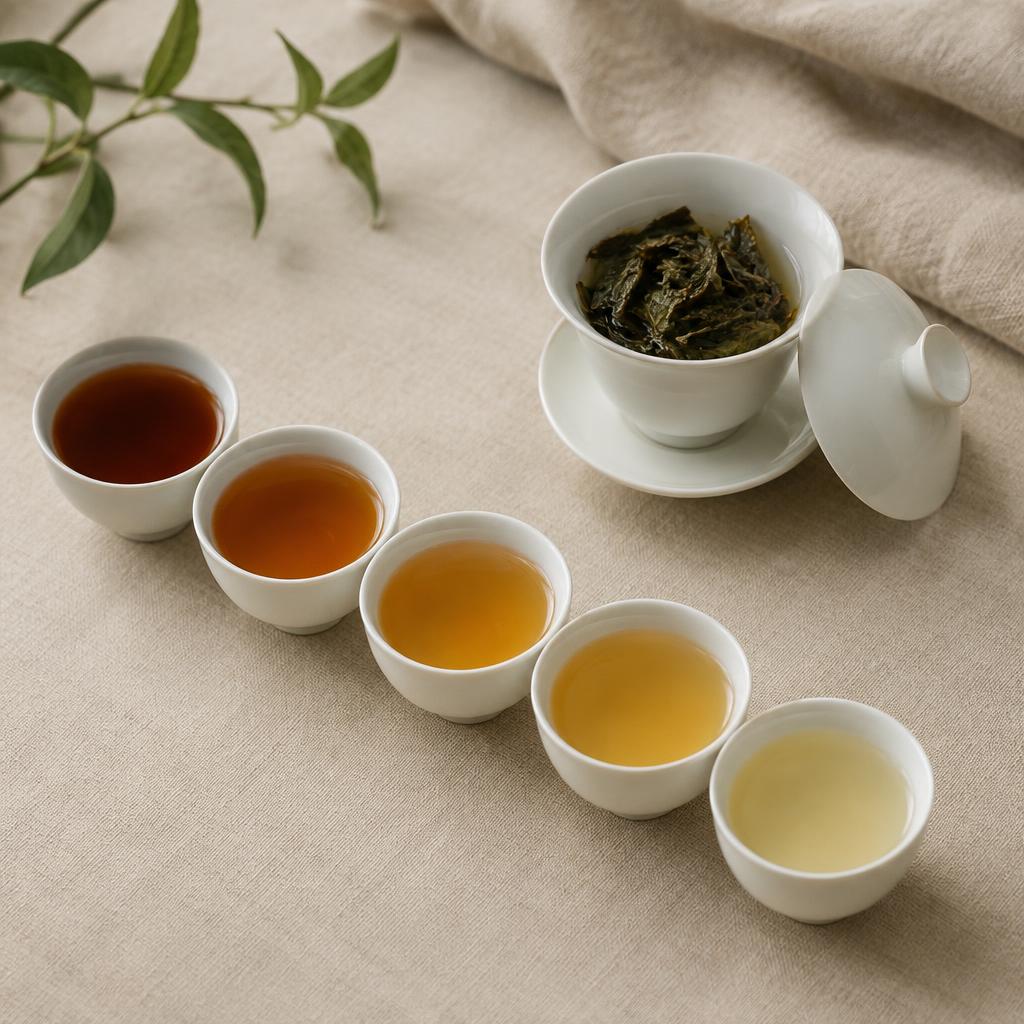
The first cup is often the most aromatic, the second the most balanced, the third the most mineral. With a tea heavily shaped byoxidation, the second time often reveals the heart of the tea, once the surface notes have given way to the body.
The caffeine level decreases with each infusion, while the sweetness persists. This is why many enthusiasts save the last herbal teas for the afternoon.
Storing leaves between sessions
Infused leaves will keep for a few hours at room temperature, with the lid open so they do not macerate. Beyond that, they may develop mould invisible mold. Do not keep them from one day to the next.
If you wish to enjoy the leaves in the evening, a time two-hour cold infusion in the refrigerator safely extends their life and produces a smooth liquor.
Whole leaf or broken leaf
Not all leaves can be reinfused in the same way. A broken leaf offers a large contact surface and releases almost everything from the first time. A whole leaf, rolled or twisted, retains reserves for the following ones. This is the first question to consider before planning a long session.
Theoxidation also plays a part. Highly oxidized teas release their theaflavins quickly, and their second time is often lighter. The rolled oolongs, partially oxidized and tightly rolled, are the most consistent over time.
A simple protocol for three infusions
For a oolong in time classic, 3 g for 200 ml of water at 90 °C:
- first infusion: 2 minutes, aromas and sweetness;
- second infusion: 2 min 30, balance and body;
- third infusion: 3 min 30, minerality and finish;
- fourth infusion optional: 5 minutes, depending on the color.
For a green tea, reduce the temperature to 75 °C and the initial time to 1 minute 30. For a white tea, start with 3 minutes at 80 °C and extend in one-minute increments.
Note that each time changes the chemical profile of the cup. The L-Theanine and caffeine decrease, while the relative proportion of minerals and certain polyphenols increases. The liquor becomes drier, more structured, sometimes sweeter on the finish.
One final tip: serve each time in a clean or rinsed cup. Residual aromas from the previous one would cloud the reading of the next, especially for delicate floral profiles.
Tasting the evolution at the counter
At HOLLIN taste counter, our contemporary Asian grocery store in Sartrouville, we are happy to serve several herbal teas of the same tea to show this evolution. It is often by the third cup that one understands why a white tea or a oolong deserves to be bought as whole leaves.
Dian VAULTIER, for HOLLIN.
Frequently Asked Questions (FAQ)
- How many times can an oolong be reinfused?
- Four to six times in time the classic method, up to ten in Gong Fu Cha. The time is extended with each infusion.
- Does the second infusion still contain caffeine?
- Yes, but less. Caffeine is extracted quickly, so the first time contains the largest share.
- Can infused leaves be kept until the next day?
- This is not recommended. Damp leaves encourage the growth of microorganisms. It is better to use them within the day.