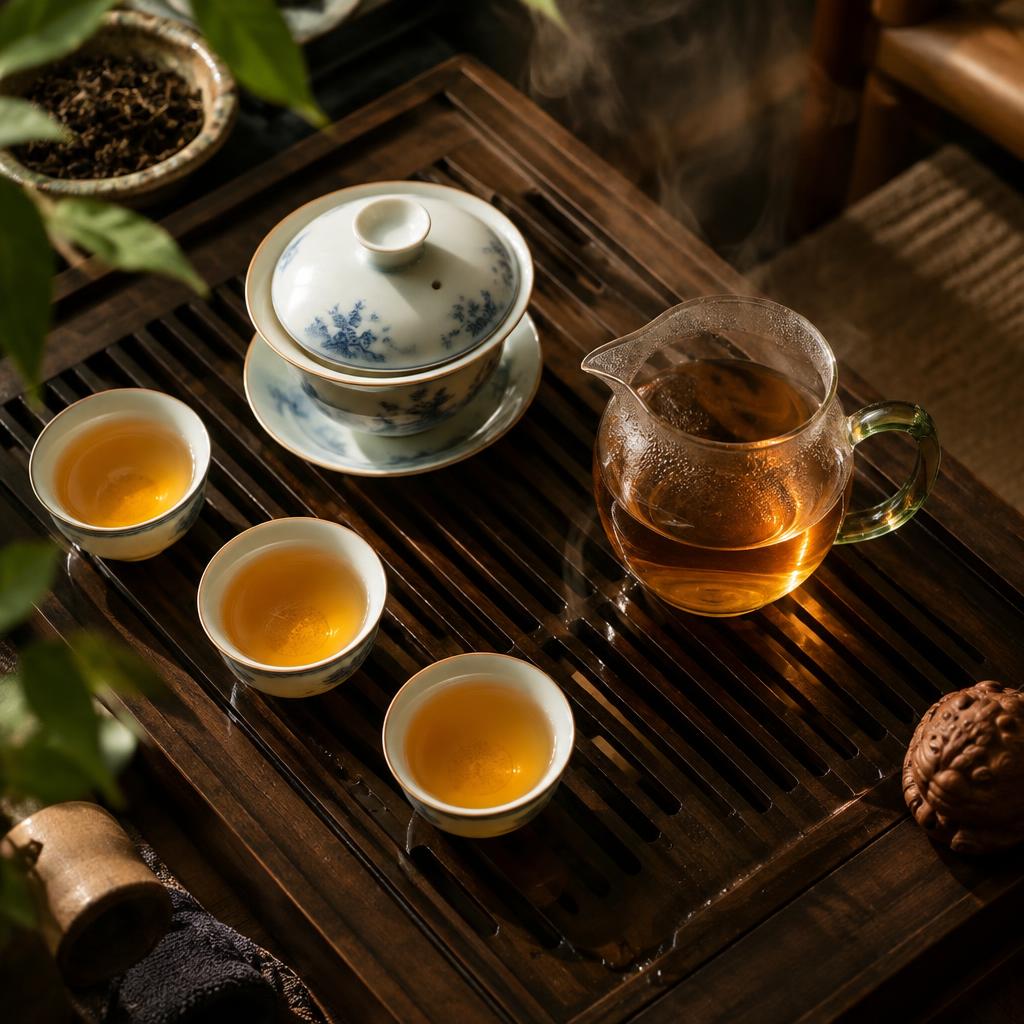
The Chinese tea ceremony (Gong Fu Cha)
Written by Dian VAULTIER·Published
In Brief
- Le Gong Fu Cha signifie littéralement « thé préparé avec art et effort ».
- Née dans le Fujian et le Guangdong sous la dynastie Qing, la pratique du gongfu cha s'est construite autour des oolongs.
- L'expertise du sommelier HOLLIN : la cérémonie du thé chinoise (Gong Fu Cha) décrypté par une Maison de Thé puriste, en thé pur, basée à Sartrouville (Île-de-France) et expédiant ses grands crus dans le monde entier.
The Gong Fu Cha signifie littéralement « thé préparé avec art et effort ». Ce n'est pas une cérémonie figée, mais une méthode d'extraction: beaucoup de feuilles, peu d'eau, des herbal teas très courtes et répétées. Elle permet de lire un cru couche par couche, de la première note aromatique jusqu'à la structure minérale.
Origin and principle
Née dans le Fujian et le Guangdong sous la dynastie Qing, la pratique du gongfu cha s'est construite autour des rolled oolongs. Le principe est inverse de l'time occidentale: au lieu de 2 g pour 300 ml pendant quatre minutes, on utilise 5 à 7 g pour 100 ml pendant 10 à 30 secondes.
Cette concentration change tout. La liquor est dense dès la première tasse, mais chaque time ne prélève qu'une fraction des composés de la feuille. On obtient ainsi six à dix tasses différentes d'un même thé.
Essential tools
Un équipement minimal suffit:
- a gaiwan de 100 à 120 ml, ou une théière en argile;
- a pichet de partage (cha hai) pour homogénéiser la liqueur;
- of the coupelles de 20 à 40 ml;
- a plateau ou bateau à thé pour recueillir l'eau.
Le pichet n'est pas décoratif: en versant toute l'time d'un coup, il garantit que chaque convive reçoit la même concentration. Retrouvez ces pièces parmi our tea objects.
The process step by step
Une session type suit cet ordre:
- réchauffer the gaiwan, pitcher and cups with hot water;
- place the leaves in the warm gaiwan and smell them dry;
- rinse the leaves briefly (5 seconds) to awaken them;
- infuse for 10 seconds, pour fully into the pitcher, serve;
- lengthen each time by 5 to 10 seconds.
The final gesture matters as much as the others: the gaiwan must be emptied to the last drop. Any residual water would continue to extract tannins and would make the next cup bitter.
The chemistry of short infusions
The compounds in the leaf do not dissolve at the same rate. Volatile aromas and L-Theanine emerge first, which explains the softness of the first cups. The caffeine follows quickly, then the catechins, includingEGCG, slower and responsible for astringency.
By limiting contact time, Gong Fu Cha maintains control over this sequence. This makes it possible to enjoy a oxidation pronounced, like that of a rock tea, without enduring the harshness of an overly long extraction.
Which teas to start with
The rolled or twisted oolongs are the natural terrain for this method: their leaves unfurl slowly and offer numerous herbal teas. The black teas Chinese and pu'erh are also very well suited to it. The green teas delicate require cooler water and even shorter times.
For a first attempt, a oolong with medium oxidation is ideal. It forgives small timing errors while clearly revealing the evolution from one cup to the next.
The most common mistakes
Gong Fu Cha is simple in principle, but a few mistakes are common among beginners. They are quickly corrected once identified:
- too much water in the gaiwan: the leaf floats and extraction becomes uneven;
- times that are too long from the first time: astringency takes over;
- water that cools between two herbal teas: the session loses its coherence;
- cold cups: the aromas close up as soon as the tea is served.
The temperature must remain stable throughout the session. A temperature-controlled kettle or small warmer avoids lengthy trips back and forth and maintains the rhythm.
A method of attentiveness
Beyond technique, Gong Fu Cha is an exercise in observation. One watches the leaf open, the colour of the liquor evolve, and smells the bottom of the empty cup where the aromas linger. Each time becomes a point of comparison with the previous one.
This attentiveness also has a physiological dimension. The L-Theanine, released early in the session, promotes a state of alert calm. Combined with the slowness of the gestures, it explains the sense of concentration described by many practitioners.
Pour progresser, notez vos réglages: quantité de feuilles, température, temps de chaque time et impressions. En quelques sessions, vous saurez adapter la méthode à chaque cultivar et à chaque degré d'oxidation.
Practice with us in Sartrouville
Le Gong Fu Cha s'apprend mieux en le voyant. Au HOLLIN taste counter, notre épicerie asiatique contemporaine à Sartrouville, nous préparons régulièrement des sessions en gaiwan pour faire goûter l'évolution d'un même cru sur plusieurs herbal teas. Venez avec vos questions, repartez avec un geste.
Dian VAULTIER, for HOLLIN.
Frequently Asked Questions (FAQ)
- Quelle quantité de thé utiliser en Gong Fu Cha?
- Environ 5 à 7 g de feuilles pour 100 ml d'eau, soit trois fois plus qu'en time occidentale, avec des temps de 10 à 30 secondes.
- Faut-il toujours rincer les feuilles?
- For rolled oolongs roulés et les pu'erh, un rinçage de quelques secondes réveille la feuille. Pour un green tea délicat, on peut s'en passer.
- Combien d'infusions peut-on faire avec les mêmes feuilles?
- Six à dix pour un bon oolong, parfois davantage pour un pu'erh. On arrête quand la liqueur devient aqueuse et perd sa structure.