Tea grades: what do OP, FOP and TGFOP mean?
Written by Dian VAULTIER·Published
In Brief
- The letters OP, FOP or TGFOP printed on a black tea are not quality ratings.
- The classification of tea leaves was established in the 19th century in India and Ceylon.
- HOLLIN sommelier expertise: tea grades decoded by a purist Tea House, specialising in pure tea, based in Sartrouville (Île-de-France) and shipping its finest teas worldwide.
The letters OP, FOP or TGFOP printed on a tea black are not quality ratings. They describe the size and theappearance of the leaf after processing. Understanding this code helps predict the extraction speed, the intensity of the liquor and the right time fortime.
A system born in British tea gardens
The classification of tea leaves was established in the 19th century in India and Ceylon. It applies mainly to black teas orthodox teas from Darjeeling, Assam and Sri Lanka. Chinese and Japanese teas use other markers, linked to the cultivar, harvest date and terroir.
The word « Pekoe » is thought to come from the Chinese bai hao, « white down », referring to buds covered in fine hairs. The term « Orange » does not refer to any citrus fruit: it is thought to evoke the royal House of Orange-Nassau, a mark of commercial prestige at the time.
Whole-leaf grades
From the simplest to the most detailed:
- OP (Orange Pekoe): long, whole leaves, without buds;
- FOP (Flowery Orange Pekoe): with a proportion of buds;
- GFOP (Golden FOP): buds with golden tips;
- TGFOP (Tippy Golden FOP): a high proportion of golden tips;
- FTGFOP and SFTGFOP: even finer selections.
Golden tips are buds rich in L-Theanine and sugars. After oxidation, they take on this tawny colour and bring notes of honey and malt to the cup.
Broken leaves, fannings and dust
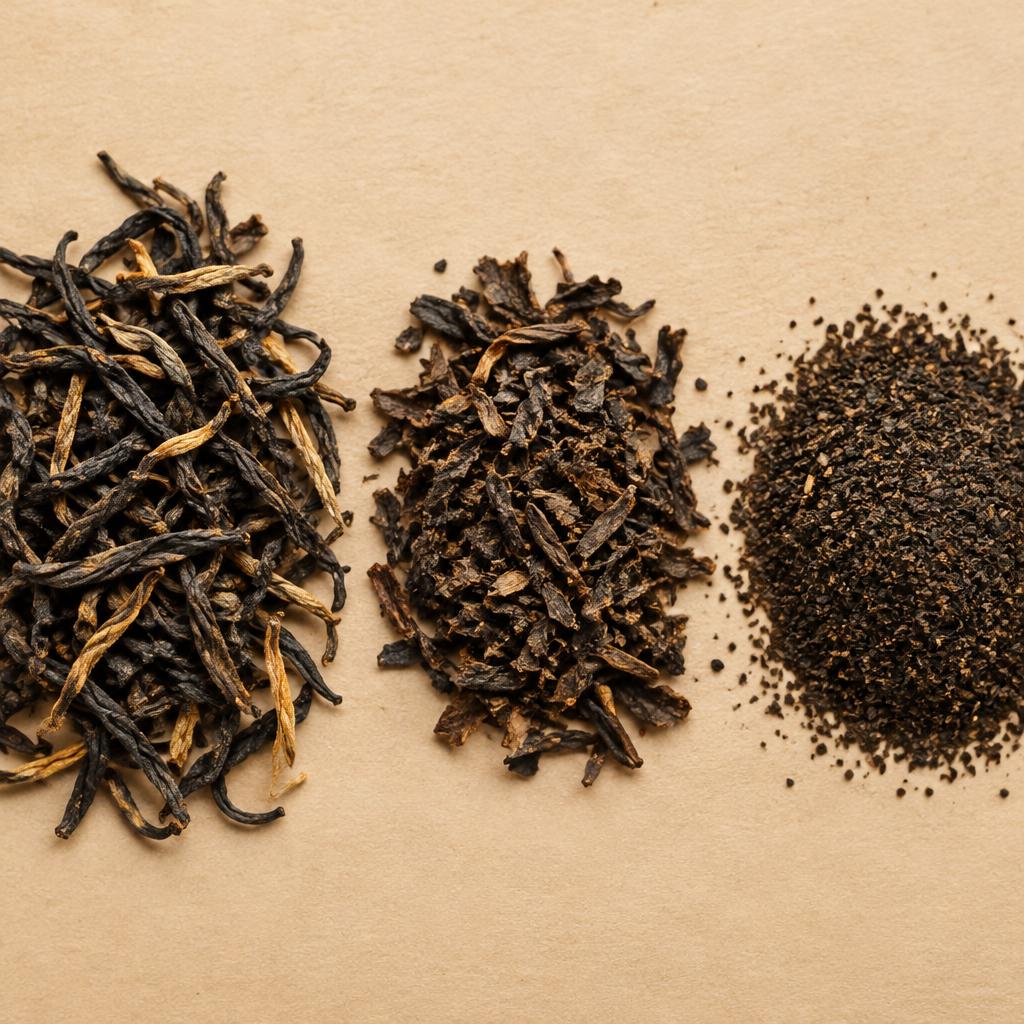
When the leaf is deliberately broken or breaks during rolling, it is called BOP (Broken Orange Pekoe). Smaller still, the Fannings and the Dust are fragments used mainly in tea bags.
Size changes extraction. The greater the contact surface, the faster the tannins and theaflavins move into the water. A BOP produces a full-bodied cup in three minutes, while a whole leaf requires more time and delivers a broader aromatic palette.
What the grade does not tell you
A mediocre TGFOP exists, just as a remarkable BOP does. The grade indicates neither the cultivar, nor the harvest season, nor the mastery of oxidation. A first flush from Darjeeling and a monsoon harvest may bear the same designation yet have nothing in common in the cup.
To assess a tea, look instead at:
- the uniformity of the dry leaves;
- the aroma of the wet leaf after time;
- the clarity and colour of the liquor;
- the length of the finish.
Adapting the infusion to the grade
For a whole leaf of the FOP or TGFOP type, use 2,5 g for 200 ml, water at 90 or 95 °C, and four to five minutes. For a BOP, reduce this to three minutes to prevent theEGCG and the tannins from dominating. Explore our black teas to compare these structures.
A whole leaf also allows a second time, which is rarely the case with broken grades. It is a useful practical test of quality.
Orthodox or CTC: two production methods
The grades described above apply to the orthodoxmethod, in which the leaf is rolled while preserving its structure as much as possible. Another method, known as CTC for Crush, Tear, Curl, crushes the leaf into small granules. It produces a liquor highly coloured and rapid, used mainly for everyday teas and tea bags.
Both methods influence theoxidation. By crushing the leaf, CTC exposes more of the cells to the air and accelerates the formation of theaflavins and thearubigins, responsible for the deep red colour. The orthodox leaf oxidises more slowly and retains more delicate notes.
Reading a complete label
Good labelling goes beyond the grade. The most useful information for assessing a black tea:
- theprecise origin: region, or even the name of the garden;
- the harvest season: first flush, second flush, monsoon, autumn;
- the cultivar when it is known;
- the method: orthodox or CTC;
- the grade, lastly, as an indication of size.
With these elements, the style of the cup can be predicted quite precisely. A second flush from Darjeeling in FTGFOP promises a full, muscatel liquor; an Assam BOP in CTC, a robust, malty cup that takes milk well.
The golden tips also contain more caffeine and L-Theanine than mature leaves. A TGFOP can therefore be both smoother and more stimulating than a simpler grade.
Compare grades in person
At HOLLIN taste counter, at our contemporary Asian grocery store in Sartrouville, we are happy to place a whole leaf, a broken leaf and a fanning side by side to show the difference to the eye, nose and palate. A lesson in reading labels, in three cups.
Dian VAULTIER, for HOLLIN.
Frequently Asked Questions (FAQ)
- What does TGFOP mean on a black tea?
- Tippy Golden Flowery Orange Pekoe: a whole leaf with a high proportion of golden-tipped buds. It is an indication of appearance, not a guarantee of taste.
- Is a broken-leaf tea poor quality?
- No. Broken leaves infuse more quickly and produce a fuller-bodied cup. They are well suited to a morning tea, with or without milk.
- Do grades apply to green teas?
- Rarely. The green teas Chinese and Japanese are described by their cultivar, terroir, harvest date and fixation method.