Tea from China or Japan: what is the difference in production
Written by Dian VAULTIER·
In Brief
- The distinction between Chinese tea and Japanese tea lies not primarily in botanical origin, but in the fixing technique, the step that stops enzymatic oxidation in the fresh lea…
- Whatever the country of origin, a green tea must be fixed shortly after harvesting to deactivate the oxidative enzymes present in the leaf, particularly polyphenol oxidase.
- The expertise of the HOLLIN sommelier: tea from China or tea from Japan, decoded by a purist Tea House with no added flavourings, based in Sartrouville (Île-de-France) and shipping its grand crus worldwide.
The distinction between Chinese tea and Japanese tea lies not primarily in botanical origin, but in the fixing technique, the step that stops enzymatic oxidation in the fresh leaf. Japan has widely adopted steaming, while China favours dry heating in a wok. This technical choice alone determines much of the final sensory profile. Understanding this difference makes it possible to anticipate the style of a green tea even before brewing it.
Fixation, the decisive stage in green tea
Whatever the country of origin, a green tea must be fixed shortly after harvesting to deactivate the oxidative enzymes present in the leaf, particularly polyphenol oxidase. Without this step, the catechins would gradually oxidise and the leaf would develop towards the profile of a oolong or black tea.
There are two main families of techniques: dry heat, applied in a wok or rotary drums, and moist heat, provided by steam. The choice of one method or the other then shapes every subsequent stage of leaf processing.
Japan and steam
A quick and even treatment
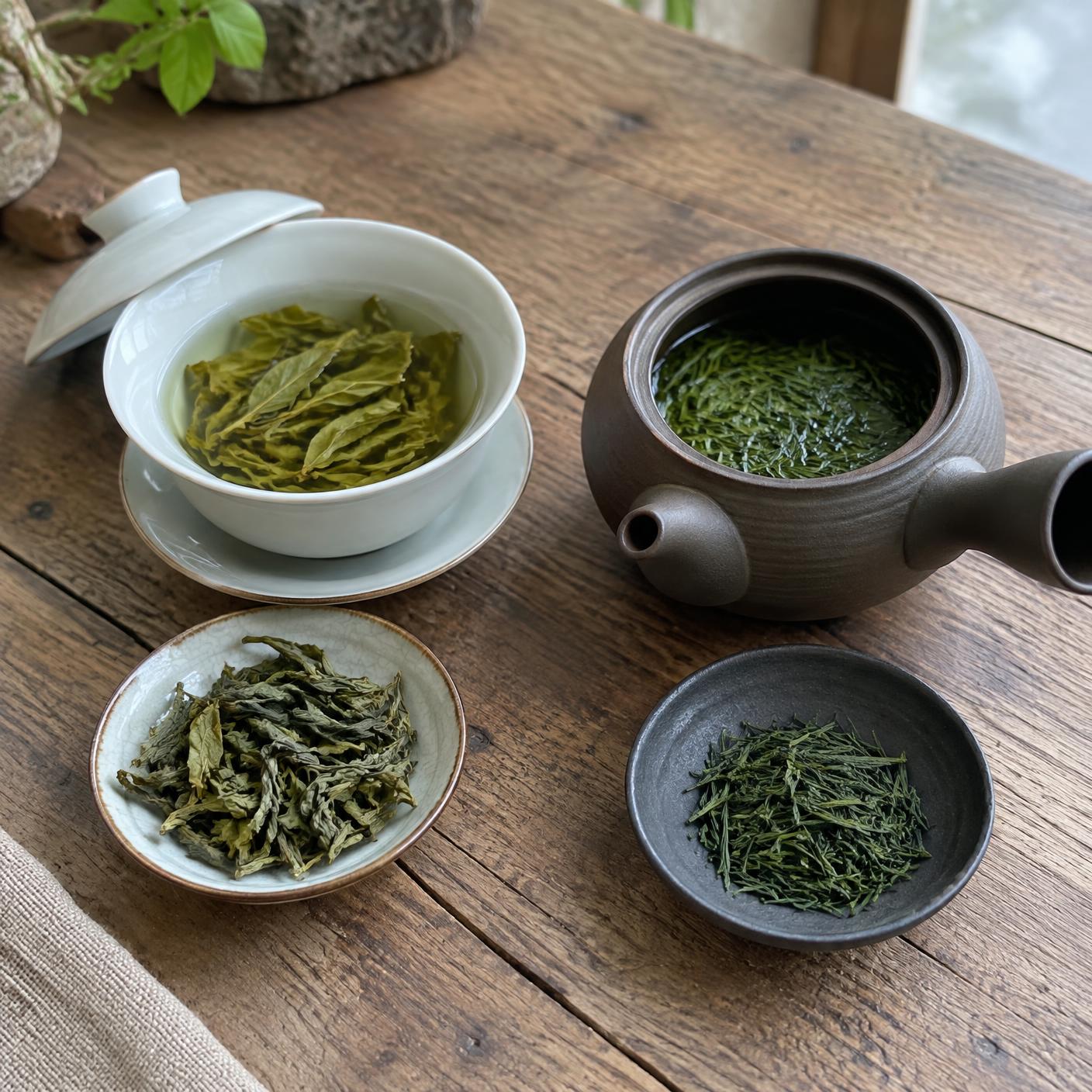
The majority of shaded Japanese green Japanese green teas, from sencha to gyokuro, are steam-fixed for around thirty seconds. This method penetrates the leaf evenly and intensely preserves the chlorophyll, explaining the characteristic emerald-green colour of Japanese teas.
In terms of flavour, steaming preserves marine, vegetal, and sometimes saline notes, with a texture often close to umami thanks to a high content of amino acids such as theanine.
China and wok firing
An artisanal and variable method
In China, wok fixation, carried out by hand or machine, heats the leaf through direct contact with a metal surface brought to a high temperature. This process, longer and more variable depending on the tea master’s skill, develops roasted, chestnut, or floral notes according to the terroir.
This diversity of techniques explains the great stylistic variety of green teas Chinese teas, from Longjing with notes of roasted chestnut to the more floral Bi Luo Chun, contrasting with the relative uniformity of steam-fixed Japanese teas.
The purist selection of HOLLIN
The house HOLLIN features green teas from both traditions, Japanese and Chinese, allowing a direct comparison of fixing methods. Each batch is described precisely in terms of its origin and processing technique, without marketing confusion between the two styles.
At the HOLLIN du Goût counter, at 22 avenue de la République in Sartrouville, open Monday to Saturday from 10h to 20h, you can smell a steamed Sencha and a wok-fired Longjing side by side, for a tangible understanding of this difference in production before making a purchase.
Frequently Asked Questions (FAQ)
- Why are Japanese green teas greener than Chinese green teas?
- Steam-fixing preserves chlorophyll better than dry heating in a wok, which explains the intense emerald-green colour of Japanese teas such as sencha, contrasting with the more golden or olive hues of green teas dry-fixed Chinese teas.
- Is Japanese green tea more bitter than Chinese green tea?
- Japanese tea often has a more pronounced vegetal bitterness, linked to its richness in catechins preserved by steaming and balanced by the umami of theanine. Chinese teas, generally less bitter, develop more roasted or floral notes.
- Can Chinese green tea be infused like Japanese green tea?
- No, the temperatures generally differ: around seventy degrees for a Japanese sencha, and up to eighty degrees for many green teas more robust Chinese teas. Water that is too hot heightens bitterness, whatever the tea’s origin.