How to prepare matcha tea: the importance of gesture and time
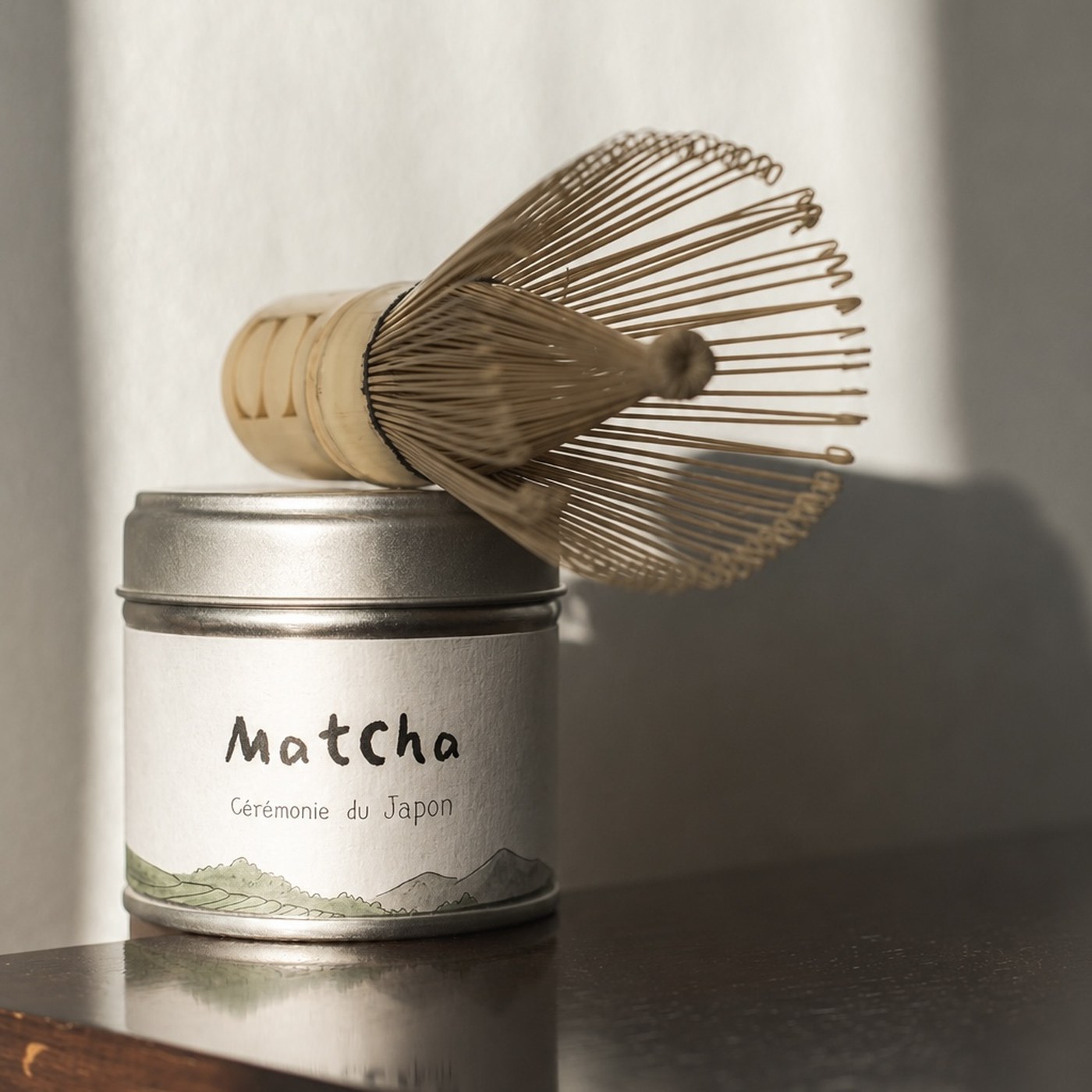
Preparing matcha tea is not merely a method. It is a way of entering the moment.
Unlike infused tea, matcha is consumed in its entirety: the leaf, ground into a fine powder, dissolves in the water. Nothing is removed, nothing is discarded. This particularity demands attention to the material, the gesture, the temperature.
This guide brings together what you need to know to prepare matcha tea with precision, without dogma, without staging. Simply what is needed for the preparation itself to become a moment.
1. Understanding the material before preparing it
Ceremonial Matcha or Everyday Matcha: which one to choose?
Two grades coexist, and they are not opposed. They serve two uses.
The ceremonial Matcha is intended to be drunk pure, prepared with water and a whisk. Its leaves come from the first spring harvests, shaded for several weeks before picking. The result: a softer, rounder powder, without harsh bitterness. This is what we offer under the reference Matcha Ceremony from Japan.
The Everyday Matcha is designed for blended preparations: lattes, iced drinks, pastries. Its structure is more pronounced, its bitterness more present, necessary to hold its own against milk or sugar. This is our Everyday Matcha.
Choosing between the two does not depend on « quality » but on the gesture. A ceremonial matcha drowned in milk loses its purpose. An everyday matcha prepared pure may disappoint. The material follows the use.
How can you recognise a quality Matcha tea?
Three signs can be read without any particular expertise.
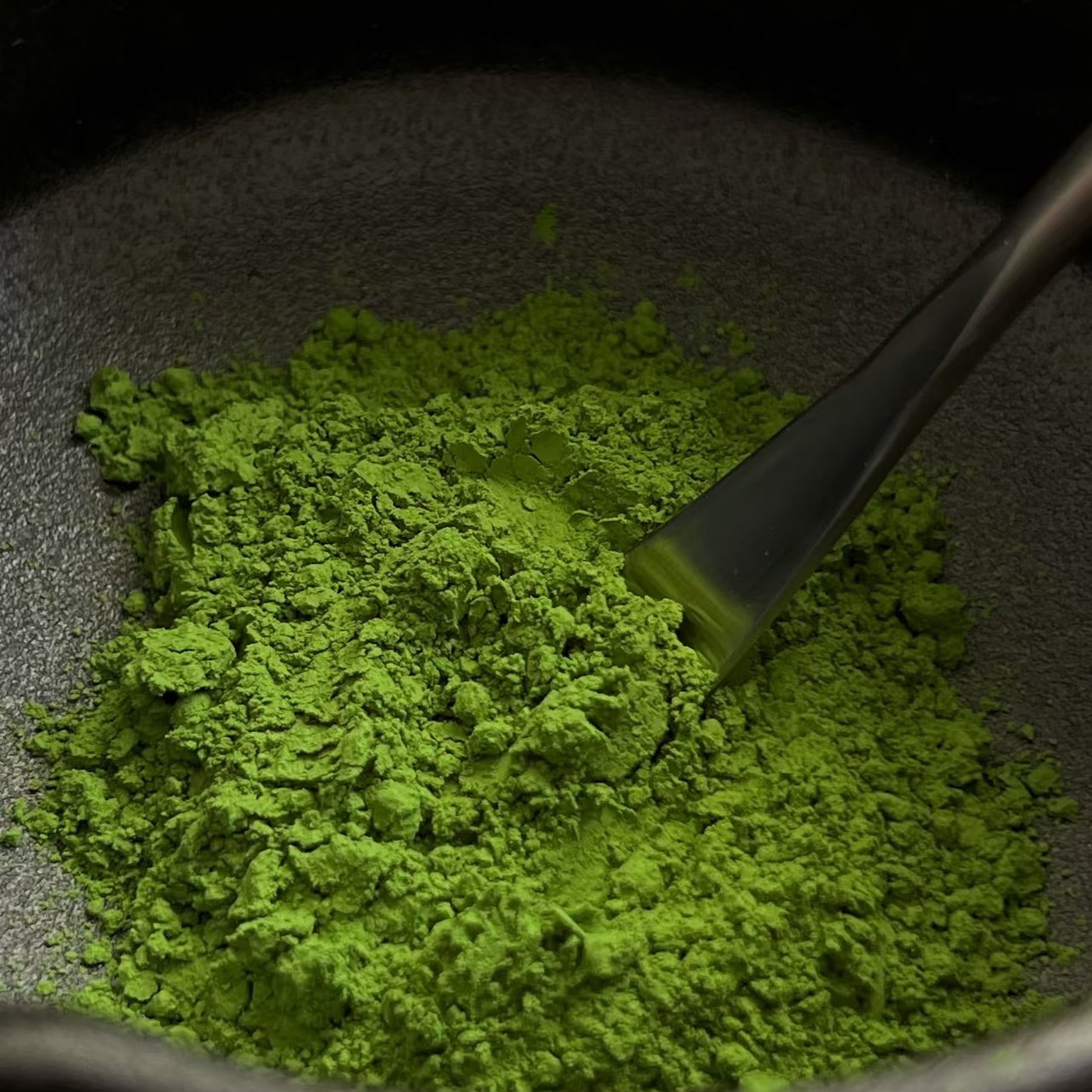
The colour, first. A quality matcha is a brilliant green, almost fluorescent, tending towards jade. A dull, yellow or olive green betrays a leaf harvested late, oxidised, or ground too long ago.
The texture, next. Rubbed between the fingers, the powder should be silky, with no perceptible grain. A sandy texture indicates a coarse grind, often from a metal mill rather than a traditional stone mill.
The aroma, finally. A good Matcha gives off a fresh, vegetal, slightly marine note. No smell of hay, dust, or mustiness.
These three signs are enough. The rest belongs to the cup.
2. The essential equipment for preparing Matcha
The bamboo whisk (chasen) and the precision of the object
The bamboo whisk, called chasen, is not decorative. Its dozens of fine tines, carved from a single piece of bamboo, are the tool that allows the water and powder to truly bind.
No metal utensil can replace it. Metal leaves its mark on Matcha: it dulls its color, alters its taste, breaks the foam instead of forming it. Bamboo, by contrast, respects the material.
A chasen is chosen according to the number of tines: sixty-four for everyday use, eighty or more for a finer emulsion. It is stored with its head upright, on its stand (kusenaoshi), so that it retains its shape and dries between uses.
The bowl (chawan): the influence of ceramics
The tea bowl is not simply a container. Its wide, open shape, with flared sides, gives the wrist room to move. A bowl that is too narrow restricts the gesture, one that is too shallow overwhelms the water.
The material matters too. Porous ceramic retains heat slightly; a smooth glaze allows the foam to glide. Antique celadons, with their blue-green glaze, are renowned for revealing the color of Matcha: the green of the powder enters into dialogue with the green of the bowl.
It is not a requirement, it is a matter of attention. The right bowl is the one the hand recognises.
3. How to prepare pure Matcha (the ceremonial ritual)
Step 1: precise measuring
For one bowl, use about 2 g of Matcha, or two chashaku spoonfuls (the dedicated bamboo spoon) or half a generously filled teaspoon.
Sift the powder directly into the chawan using a small sieve. This step is not optional: matcha, being very fine, naturally forms clumps when it leaves the tin. Without sifting, no emulsion will be smooth.
Step 2: the water temperature
A crucial point: never use boiling water. Water at 100 °C burns the powder, abruptly releases the tannins, and turns Matcha into an acrid drink.
The ideal temperature is between 75 °C and 80 °C. If you do not have a temperature-controlled kettle, bring the water to the boil, then let it rest off the heat for two to three minutes. Then pour approximately 70 ml of simmering water, never boiling, over the sifted powder.
Step 3: the gesture
Hold the chasen without tension, keeping the wrist supple. The movement is not circular: it follows the shape of a « W » or an « M », back and forth, quickly and evenly.
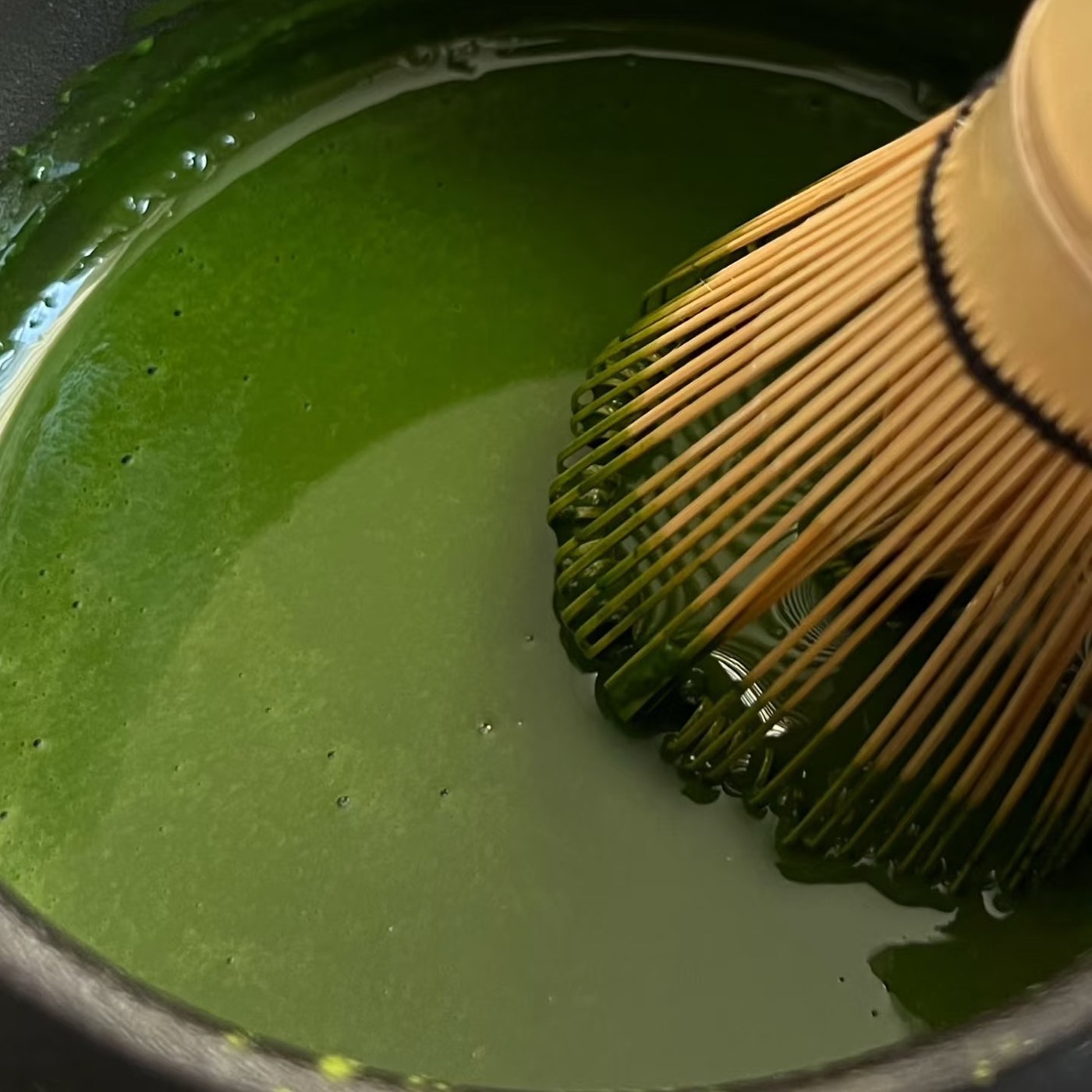
The gesture comes from the wrist, never the arm. Around fifteen seconds is enough. The foam forms by itself, dense, with fine, tightly packed bubbles, even across the surface of the bowl.
Remove the Chasen with a spiral movement at the center, so as not to break the foam. Drink without delay: Matcha is enjoyed hot, with the powder still suspended.
4. How to prepare a Matcha latte or iced Matcha (every day)
Preparing a Matcha latte
A Matcha latte is not made by drowning the powder in hot milk. It requires a two-stage preparation.
First, prepare a concentrate : 2 g of sifted matcha, 50 ml of water at 75 °C, whisked with the chasen until a fluid, frothy paste is obtained.
Then add 150 to 200 ml of warm plant-based milk. The oat milk is particularly well suited: its natural roundness and slight sweetness embrace the structural bitterness of matcha without masking it. Almond milk accentuates the vegetal notes; rice milk remains more neutral.
Pour the milk gently over the concentrate, without mixing vigorously, to preserve the foam.
Iced Matcha: a different freshness
Prepared cold, matcha reveals another facet. The bitterness fades, the vegetal sweetness lingers, the profile becomes longer and more vibrant.
Two methods coexist. The most direct: 2 g of sifted matcha, 200 ml of very cold water, shaken in a bottle for fifteen seconds. The slower method: the same ratio, left overnight in the refrigerator for a cold extraction of perfect clarity.
Neither sugar nor ice added to the infusion: freshness alone is enough.
5. Storage: how to preserve the freshness of your Matcha?
Matcha is a delicate tea. Ground into powder, it exposes an immense surface area to air, light and moisture. Three elements that quickly oxidise it, dull its colour, close down its aromas.
Three rules are enough to protect it:
- • Store it in an airtight container, opaque, protected from direct light.
- • Keep it in the refrigerator once the tin has been opened, allowing it to return to room temperature before each use. Moisture from condensation would damage the powder.
- • Consume it within four to six weeks after opening. Beyond that, the color begins to fade.
A well-stored matcha remains what it was the day it was opened. That may be the first gesture of care we owe it.