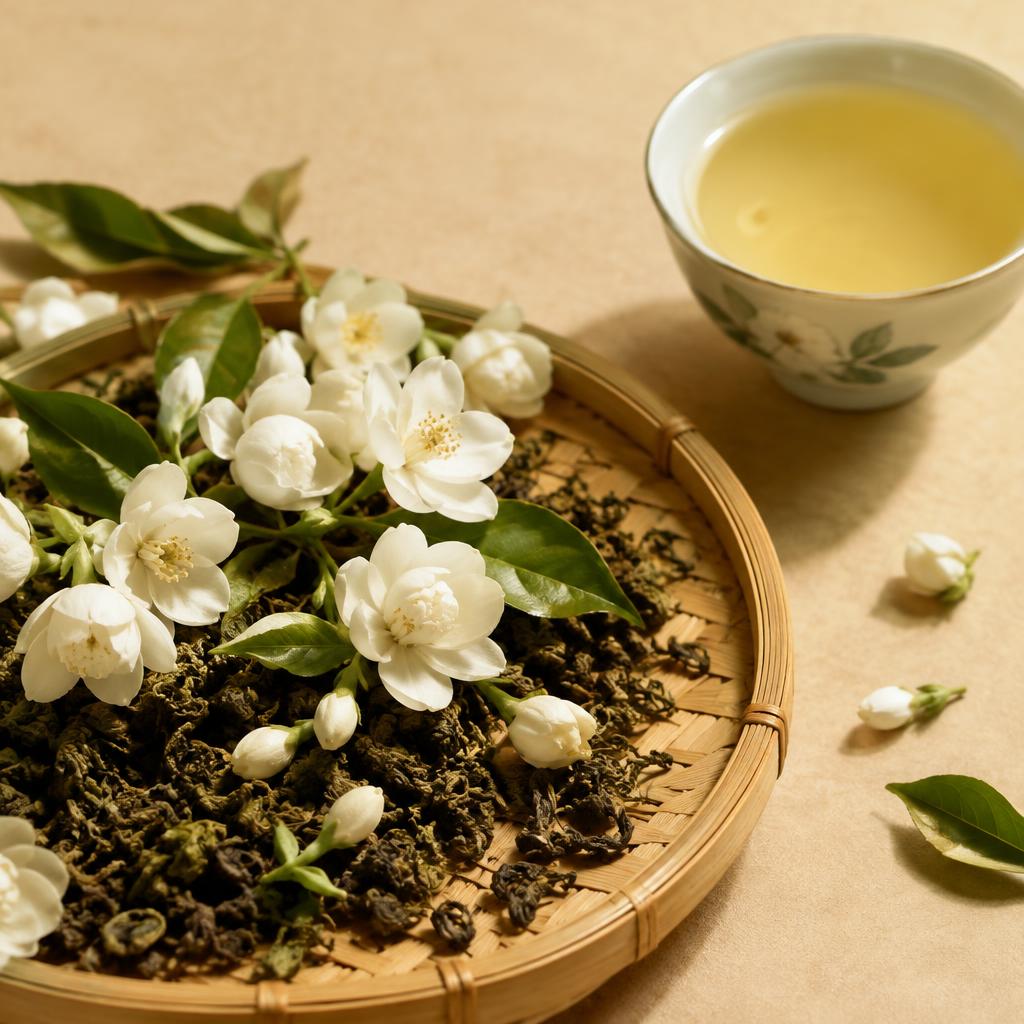
Where do the floral notes (Jasmine) come from?
Written by Dian VAULTIER·Published
In Brief
- A tea that smells of orchid, lilac or jasmine needs no bottle.
- Camellia sinensis leaves store aromatic precursors bound to sugars, known as glycosides.
- HOLLIN's sommelier expertise: where the floral notes (Jasmine) come from, decoded by a purist Tea House specialising in pure tea, based in Sartrouville (Île-de-France) and shipping its grands crus worldwide.
A tea that smells of orchid, lilac or jasmine needs no bottle. Floral notes arise from two sources: the leaf itself, through its cultivar and its oxidation, or an enfleurage through contact with real flowers. Understanding these mechanisms makes it possible to recognise an authentic floral tea from the very first sip.
The molecules of floral fragrance
Whole-leaf Camellia sinensis store aromatic precursors bound to sugars, known as glycosides. During withering and rolling, enzymes release volatile compounds. The most important for the floral register:
The role of the cultivar and terroir
Each cultivar has its own aromatic potential. Some, selected in Taiwan or Fujian, are renowned for their high linalool content. Altitude slows the leaf's growth, allowing it to concentrate its precursors: this is why high-mountain rolled oolongs are often more floral than their lowland neighbours.
Plant stress also plays a role. Insect bites, on certain Taiwanese teas, trigger chemical defences that produce notes of honey and white flowers. The terroir thus shapes the liquor even before processing.
Partial oxidation, a floral laboratory
Theenzymatic oxidation transforms the catechins and releases the aromas. An oolong oxidized between 15 and 30% often reaches its floral peak: orchid, gardenia, lilac. Beyond that, the notes shift towards ripe fruit, then honey and wood.
The tea master gently tosses the leaves to bruise their edges. This repeated gesture creates localized oxidation, which explains why our Oolong teas can offer several aromatic layers in the same cup.
Jasmine: the art of enfleurage
The jasmine tea traditional contains no essence. The flowers are picked during the day, while still closed, then mixed with the green tea in the evening, as they open and release their fragrance. The highly absorbent leaf captures the volatile compounds overnight.
The process is repeated:
- the wilted flowers are removed by hand in the morning;
- the tea is gently dried, then brought back into contact with fresh flowers;
- the finest grades undergo up to six or seven rounds.
It is this process that distinguishes our jasmine teas from a simply flavored tea: the fragrance is integrated into the leaf and evolves over the course of the herbal teas.
Recognizing a natural floral character
A floral character obtained through the leaf or enfleurage is evolving: it changes between the first and the third time, mingles with the vegetal notes and leaves a gentle finish. An applied fragrance remains identical from one cup to the next, often very powerful on the dry leaf and quickly flat on the palate.
The L-Theanine of the green teas and rolled oolongs light extends this sensation by bringing an umami roundness that supports the fragrance without overpowering it.
Withering, the first stage of fragrance development
Before any oxidation, the fresh leaf is spread out to lose some of its water. This withering, which lasts several hours, activates glycosidase enzymes. These break the bonds between sugars and aromatic precursors, releasing linalool and geraniol.
Too short a withering leaves the tea grassy; too long, and it produces overripe fruit notes. The tea master monitors the aroma of the leaves hour by hour, until detecting the moment when the floral fragrance appears. It is expertise that cannot be learned from a manual.
Brewing a floral tea without damaging its notes
Floral molecules are volatile. Water that is too hot evaporates them before they even reach the cup, and releases excessive amounts of catechins and theEGCG, which mask the fragrance with their bitterness.
Guidelines for preserving floral notes:
- jasmine green tea: 75 to 80 °C, 2 to 3 minutes;
- lightly oxidised floral oolong: 85 to 90 °C, herbal teas short and repeated;
- white tea: 80 °C, time long and gentle;
- a fine, flared cup to release the aroma.
Also smell the lid of the gaiwan or teapot immediately after the'time. The lightest compounds condense there, often offering the most precise expression of the floral fragrance.
Finally, store these teas away from air in an airtight caddy. The floral fragrance is the first to fade over time, long before the structure of the liquor.
Smell Before Choosing
Nothing replaces the nose. At HOLLIN taste counter, our contemporary Asian grocery in Sartrouville, you can smell the dry leaf, then the wet leaf, and compare a jasmine scented with a oolong mountain floral. Two paths to the flower, the same commitment to purity.
Dian VAULTIER, for HOLLIN.
Frequently Asked Questions (FAQ)
- Does jasmine tea contain essential oils?
- A jasmine tea traditional, no. It is scented through contact with fresh flowers, over several consecutive nights. The wilted flowers are then removed.
- Which tea should you choose for floral notes without jasmine?
- A oolong lightly oxidised high-mountain, or a green tea spring. Their floral notes come from the cultivar, altitude and carefully controlled oxidation.
- Why do floral notes change from one infusion to the next?
- Volatile compounds are not all extracted at the same rate. The lightest dominate the first time, while the heavier ones emerge later.