What is a 'pyrogenic' (roasted) note in tea?
Written by Dian VAULTIER·
In Brief
- A pyrogenic note refers to the full range of roasted, toasted or smoky aromas created when the leaf passes through fire.
- It all begins with fixation. A few minutes in a wok heated to between 200 and 300 °C are enough to deactivate the enzymes responsible for oxidation.
- HOLLIN sommelier expertise: what is a 'pyrogenic' (roasted) note in tea, decoded by a purist Maison of Tea, with no added flavourings, based in Sartrouville (Île-de-France) and shipping its fine teas worldwide.
A pyrogenic note refers to the full range of roasted, toasted or smoky aromas created when the leaf passes through fire. It never comes from an addition: it is produced by dry heat on living plant matter.
The craft of fire: fixation, roasting and smoking
It all begins with fixation. A few minutes in a wok heated to between 200 and 300 °C are enough to deactivate the enzymes responsible for oxidation. This gesture, called shaqing in China, stabilises the leaf. Depending on the movement of the hand and the temperature of the metal, it leaves a more or less pronounced roasted imprint: hazelnut, puffed rice, warm bread.
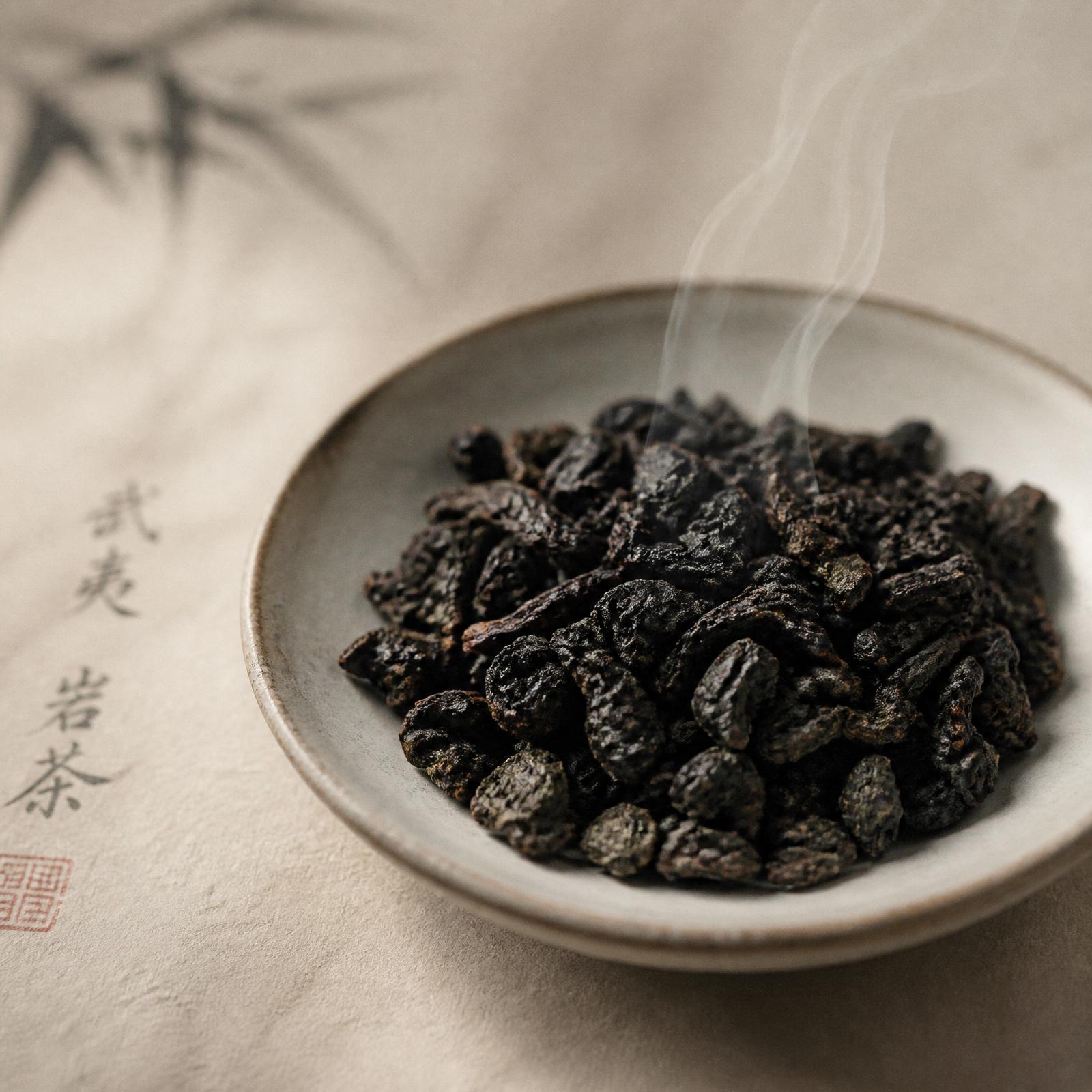
Next comes roasting, or hongbei. It takes place after shaping, over embers or in a heated basket, at low temperature and over several hours, sometimes in several rounds spaced weeks apart. This is the domain of the rock oolongs, where the pyrogenic note structures the liquor and lengthens the finish.
Smoking, finally, is a distinct operation: the leaf is exposed to the smoke of resinous wood, as in Fujian black teas. Here again, nothing is added in liquid or concentrated form. Smoke is a flow, not a synthetic flavouring.
A failed roasted note does exist, however: it is dry, ashy, monolithic, and it overwhelms the leaf. A well-mastered pyrogenic note does the opposite: it carries the terroir and fades away, allowing the material to speak.
The chemistry of the leaf: intense flavours without any added flavourings
Heat triggers two families of reactions. The Maillard reaction, between the amino acids in Camellia sinensis, particularly L theanine, and reducing sugars, produces pyrazines and furans, responsible for notes of roasted hazelnut, cocoa and bread crust.
The caramelisation of sugars adds roundness and a slight sweetness that balances the tannins. At higher temperatures, the degradation of lignins releases phenolic compounds reminiscent of burnt wood and camphor.
This is why the pyrogenic note is a marker of savoir-faire rather than an artifice: it cannot be achieved without fire, and it does not survive imprecise heating. It reflects the artisan's precise reading of the leaf.
At HOLLIN, we select oolongs roasted and black teas fire-crafted, tasted lot by lot, as pure tea. Visit the Hollin du Goût counter, 22 avenue de la République in Sartrouville, to compare a light roast and a long roast in the same session.
Frequently Asked Questions (FAQ)
- Does a pyrogenic note mean that the tea has been burnt?
- No. A burnt tea produces a dry, ashy bitterness that masks everything else. A masterful pyrogenic note remains enveloping, sweet on the finish, and allows the terroir of the leaf to emerge behind the roasted character.
- How can you distinguish natural roasting from an added roasted flavouring?
- An added flavouring remains identical from the first infusion to the last and asserts itself immediately on the dry nose, in a very linear way. Natural roasting evolves: it recedes over the course of the herbal teas successive brews and gradually gives way to the floral or mineral notes of the leaf.