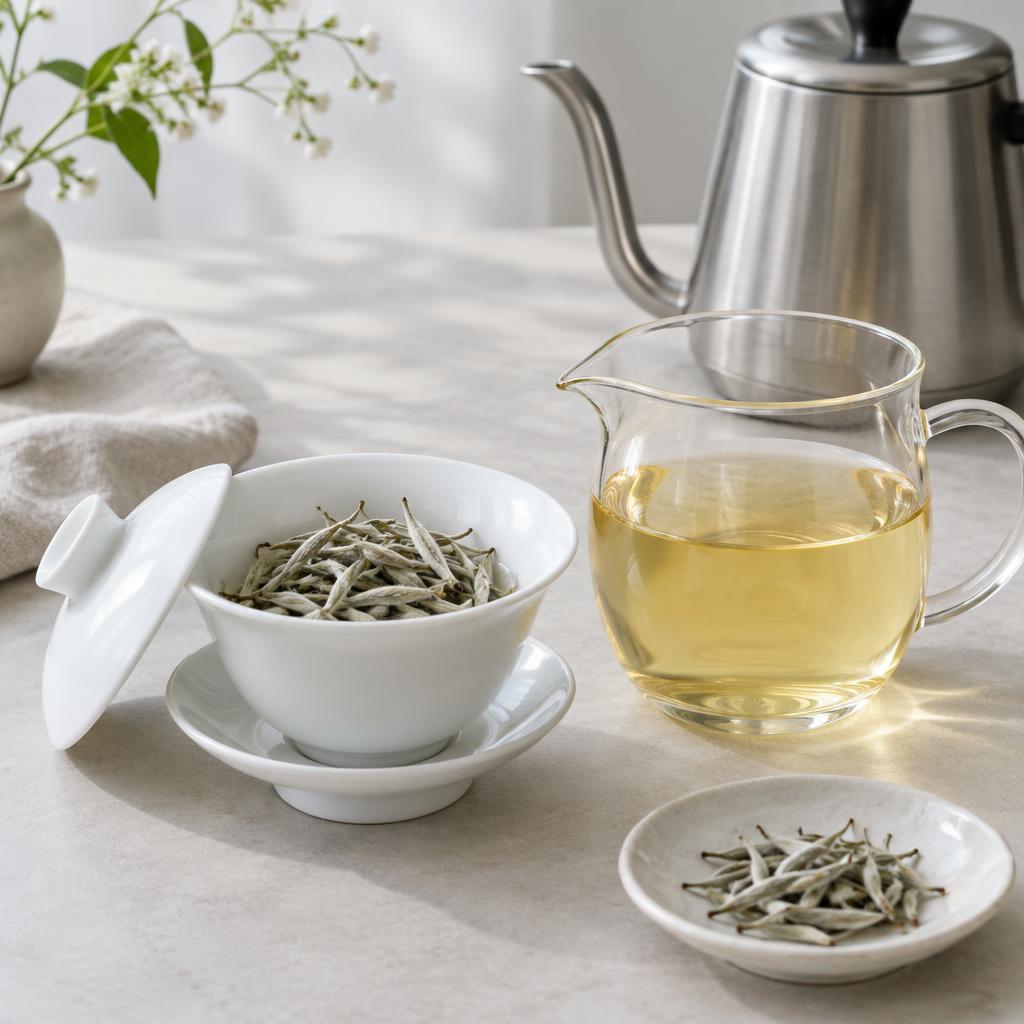
What water temperature for white tea?
Written by Dian VAULTIER·
In Brief
- The right temperature for a white tea depends on the product, the dosage and the brewing method.
- The 70 to 80 °C range is an option, not a requirement.
- HOLLIN sommelier expertise: what water temperature for white tea, explained by a purist Tea House specialising in pure tea, based in Sartrouville (Île-de-France) and shipping its Grand Crus worldwide.
The right temperature for a white tea depends on the product, the dosage and the method oftime. Start with the instructions on its packaging rather than a rule applied to the entire category. Moderate-temperature water can produce a delicate cup, while hotter water suits certain teas, provided the contact time is controlled.
What water temperature for white tea?
The 70 to 80 °C range is an option, not a requirement. Some white teas are prepared with considerably hotter water. In the absence of instructions, you can try 80 °C as an exploratory starting point, then taste. This value defines neither the quality of the tea nor its ideal preparation: it simply serves to establish a reproducible first trial.
Water close to boiling does not instantly destroy all the beneficial compounds in white teaIt mainly changes the speed and balance of theextraction. Depending on the leaves, the dosage and the duration, it can produce more body or accentuate an unpleasant bitterness. There is therefore no universal rule requiring 98 °C either.
Understanding what processing changes
The white tea is generally produced by withering followed by drying, with variations in production. It can include buds and more developed leaves: it is not limited to only the youngest shoots. This relatively simple process does not, in itself, imply extreme sensitivity to hot water. The Cultivar and harvesting conditions also contribute to the character of the Liquor, without being sufficient to establish a universal temperature.
During production, <a href='https://fr.wikipedia.org/wiki/Brunissement_enzymatique' target='_blank' rel='noopener noreferrer'>enzymatic oxidation</a> may occur, particularly during withering. This phenomenon should be distinguished from the gradual deterioration that occurs during storage. Neither supports the idea of thermal shock automatically ruining the cup. To adjust thetime, rely on the product instructions and the sensations you actually observe.
Comparing Bai Hao Yin Zhen and Bai Mu Dan
Bai Hao Yin Zhen consists of buds, while Bai Mu Dan combines buds and leaves. This difference helps explain their appearance, but it does not require two fixed temperatures. In particular, the down on the buds is not enough to prove that water above 75 °C would necessarily produce immediate bitterness.
To compare them effectively, prepare each tea according to its own recommendations. Then note the intensity, texture, bitterness, and persistence. If you want to isolate the effect of temperature on the same tea, keep the leaves, water, vessel, and duration exactly the same. Comparing two products with several different parameters does not make it possible to identify the cause of a difference.
Preparing a trial that you can reproduce
Weigh the leaves and measure the water rather than counting spoonfuls: large buds take up a great deal of space for a limited mass. In the absence of instructions, a trial using 2 grams per 200 milliliters for three minutes provides a practical guideline, not a standard. Use a filter spacious enough to allow the water to circulate.
A temperature-controlled kettle makes repetitions easier, but a thermometer works too. The temperature displayed before pouring is not exactly that of the mixture in the cup. A cold vessel absorbs some of the heat. Always preheat it, or never do so, during your comparisons to keep conditions as consistent as possible.
- Record the selected temperature before pouring the water. • Start the timer when the water first comes into contact with the leaves. • Drain completely as soon as the allotted time is up. • Let the drink cool slightly before tasting. • Record your impression, then change only one parameter for the next trial, without adjusting the dosage and duration at the same time.
Correcting a bitter or overly weak cup
If the cup is bitter, start by shortening thetime while keeping the temperature and amount unchanged. If it remains unpleasant, then try cooler water, maintaining this new duration. Distinguish bitterness, which is a taste, fromastringency, the drying sensation in the mouth. Both can be heightened by over-extraction.
If the result seems weak, first check that the leaves were properly immersed and that the water volume is correct. Then slightly increase the steeping time, or raise the temperature for the next trial, but not both at once. A pale color does not necessarily indicate a lack of flavor: also assess the texture and finish.
Adjusting the time, water, and subsequent infusions
Cooler water generally slows extraction, but extending thetime indefinitely does not guarantee balance. Three to five minutes may suit certain large-cup preparations, without serving as a benchmark against the green tea. A method using a large amount of leaves and little water calls instead for short infusions, following the tea’s instructions.
For another time of the same leaves, return to the available recommendations and observe the result before extending the time. If the cup remains dull after several attempts, also consider the water: a chlorinated smell or high mineral content can hinder the tasting experience. Compare with another drinking water while keeping all other parameters unchanged.
Checking storage before raising the temperature
Tea that absorbs moisture or odors may seem less distinct, and hotter water will not solve the problem. Keep the leaves in a dry, opaque, tightly sealed food-safe container, away from steam and spices. A smaller container limits the amount of free air space, but this alone does not guarantee better storage.
A double lid is not automatically airtight, and the inner lid does not need to touch the leaves. Above all, check the seal, cleanliness, and absence of odor in the container. To choose your equipment according to these criteria, see <a href='/collection/objets-pour-le-the'>tea accessories</a>, without confusing decorative appearance with effective protection against everyday exposure.
Refining your preparation with HOLLIN du Goût
To continue your experiments, see <a href='/category/tea'>our teas loose leaf</a> and follow the instructions specific to your chosen product. You can also visit the HOLLIN counter at Goût, a contemporary Asian grocer in Sartrouville, with your preparation notes. Stating the tea, dosage, temperature and duration will help you ask a precise question about your cup.
Finally, keep the same objective throughout your comparisons: to achieve the balance you enjoy, not to reach a supposedly perfect temperature. The white tea contains a variable amount of caffeine and is not necessarily caffeine-free; a time gentle does not allow it to be quantified. Your notes are there to adjust the taste. Signed Dian Vaultier.
Frequently Asked Questions (FAQ)
- Can white tea be brewed with boiling water?
- Some products are suitable for this, but it is not a general rule. Follow their instructions first. If the cup becomes too bitter, reduce the duration or lower the temperature in a new trial, changing only one parameter at a time.
- Does Bai Hao Yin Zhen require water at 70 °C?
- No. Its bud composition does not determine a mandatory temperature. The product recommendations are the best starting point, then tasting allows you to adjust the preparation gradually.
- How can you achieve more flavour without increasing bitterness?
- Check the dosage, water volume, and proper immersion of the leaves. Then test a slightly longer duration at a constant temperature. If bitterness appears before the desired intensity, return to the previous setting and separately try a slightly higher dosage.