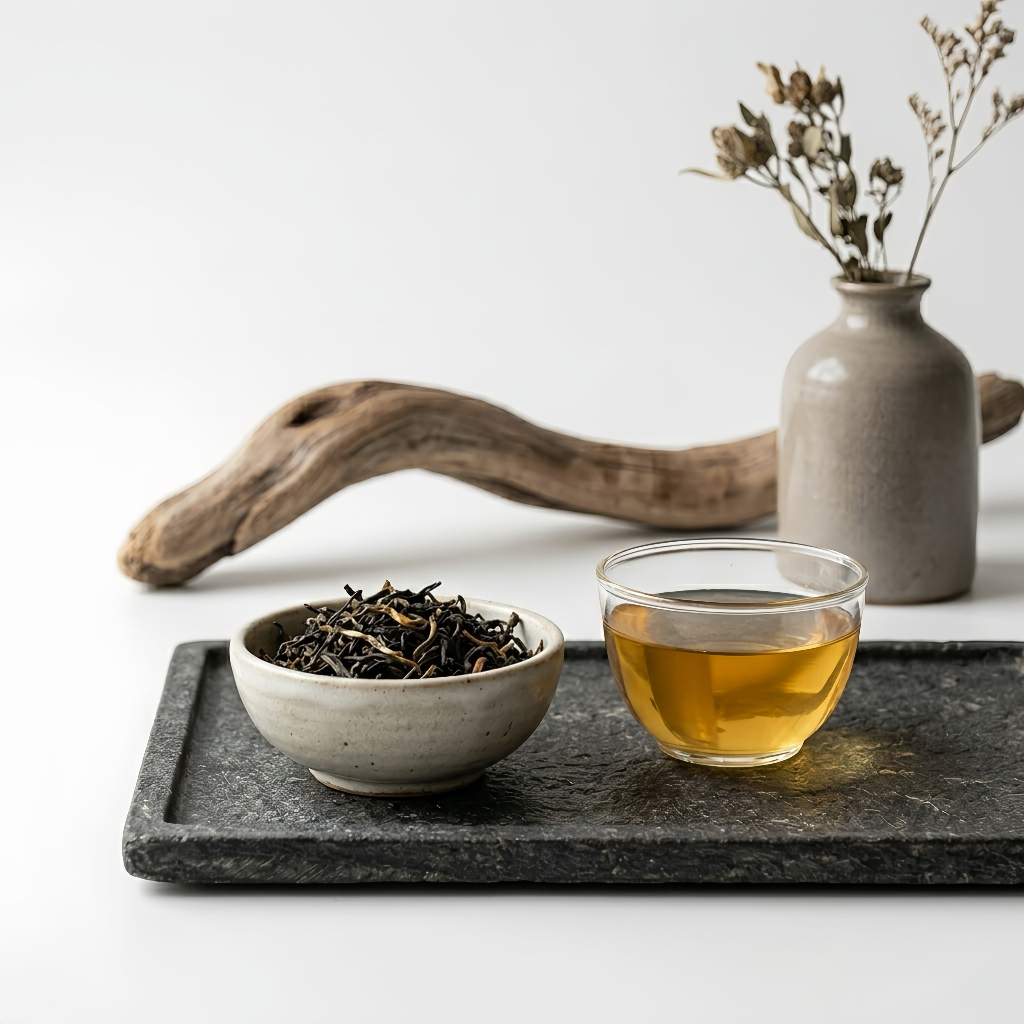
Tea is not a drink. It is a state.
For a long time, tea has been understood as a material: a leaf, an origin, a tradition. In a contemporary context, this reading is no longer sufficient.
The same leaf can produce radically different experiences, depending on one factor alone: how it is prepared.
At HOLLIN, tea is not a fixed product, but a modular system, a balance between energy, softness, and sensation.
A different energy from coffee
Tea contains caffeine. But it does not act like coffee. Where coffee stimulates sharply and immediately, tea unfolds more gradually, more steadily.
It is not an opposition. It is another way of entering a state.
- - Coffee accelerates
- - Tea accompanies
Not all leaves produce the same intensity
As an indication:
- - White tea: 10-15 mg
- - Green tea: 20-30 mg
- - Oolong: 30-45 mg
- - Black tea: 45-70 mg
Coffee: 150-200 mg.
But these figures remain secondary. The real variable is not only the leaf. It is the water.
Temperature transforms tea
The same infusion can be gentle or stimulating.
At higher temperatures, extraction becomes denser, more present. At lower temperatures, it becomes lighter, more fluid.
The same tea can become: energising in the morning, balanced in the afternoon, calming in the evening. Tea is never fixed. It is shaped.
A question of state
Today, one no longer chooses only a type of tea. One seeks a sensation.
To focus To slow down To breathe To lighten
At HOLLIN, tea is not a category. It is a daily practice.
No added aromas. No excessive claims. Just the leaf, and the way it is infused.
Drinking tea is not consumption. It is attunement.